| Welcome, Guest |
You have to register before you can post on our site.
|
| Online Users |
There are currently 385 online users.
» 6 Member(s) | 374 Guest(s)
Applebot, Baidu, Bing, Facebook, Yandex, JoJo_Jost, nintus, Ryszard
|
| Latest Threads |
[Article] What We Actuall...
Forum: Voynich Talk
Last Post: DG97EEB
15 minutes ago
» Replies: 2
» Views: 37
|
Voynich's anatomy
Forum: Imagery
Last Post: ololololo
45 minutes ago
» Replies: 111
» Views: 10,558
|
[split] Aga Tentakulus' L...
Forum: Analysis of the text
Last Post: ololololo
50 minutes ago
» Replies: 86
» Views: 35,042
|
Assumptions baked into th...
Forum: Physical material
Last Post: ololololo
53 minutes ago
» Replies: 40
» Views: 834
|
No text, but a visual cod...
Forum: Theories & Solutions
Last Post: Rafal
56 minutes ago
» Replies: 1,913
» Views: 1,319,614
|
Why and how the text coul...
Forum: Theories & Solutions
Last Post: JoJo_Jost
2 hours ago
» Replies: 364
» Views: 61,996
|
Spencer Coll. MS. 65: an ...
Forum: Imagery
Last Post: Pierre Dumont Himself
2 hours ago
» Replies: 12
» Views: 386
|
EVA "qo" in 15th century ...
Forum: Analysis of the text
Last Post: BessAgritianin
6 hours ago
» Replies: 18
» Views: 2,093
|
German medicinal charm re...
Forum: Marginalia
Last Post: Koen G
Yesterday, 08:14 PM
» Replies: 2
» Views: 141
|
I am not convinced by the...
Forum: Provenance & history
Last Post: proto57
Yesterday, 02:03 PM
» Replies: 53
» Views: 2,448
|
|
|
| Dioscorides and Tacuinium sanitatis as sources of VM imagery |
|
Posted by: Bernd - 26-12-2024, 10:52 PM - Forum: Imagery
- Replies (2)
|
 |
There are several similarities shared between the history of the Dioscorides and Tacuinium sanitatis manuscripts and both appear to have served as templates for VM imagery. Both manuscripts most likely were prestigious luxury objects created for bibliophile nobles rather than tools to be used for practicing medicine or another profession. All existing copies of both manuscripts appear to have been derived from now lost precursors and both manuscripts appear to have been copied by individually compiling text and images instead of copying existing books page by page. Which means that stock image collections must have existed in the workshops carrying out the deed.
Furthermore it is extremely unlikely any commoner ever had access to those books which were considered treasures (that also explains the extraordinary shape they are in today, they were never used). There must have been much simpler budget copies for mere mortals which did not survive the centuries. If illustrations created for such masterpieces became available to a broader audience than probably through workshops which reused them in other works.
Quote:As the two late 14th-century Tacuinum manuscripts, Vienna 2644 and Rome 4182 are similar to one another but contain different inaccuracies, it seems to us that they must have been derived from a common, more accurate model. Based on other similarities and differences between Vienna 2644 and Rome 4182, Hoeniger (2006) arrived at the same conclusion. Not only did more Tacuinum manuscripts exist, one of them must have predated the Vienna 2644 and Rome 4182 manuscripts. Moreover, the artists who drew this hypothesized model manuscript must have been familiar with the plant material, as it is drawn with a good degree of detail and accuracy in these two manuscripts.
Quote:According to Hoeniger (2006), a hypothetical reconstruction of the relationships among these manuscripts would run like this: Giangaleazzo had a lavish Tacuinum sanitatis created in the first place for his own personal enjoyment and that of his wife, but this version has not survived. Soon afterwards, he commissioned the Paris and Vienna manuscripts as beautiful gifts to be bestowed on family and friends on highly politicized occasions. As the manuscripts came to be admired at courts in northern Italy and in Vienna where Verde Visconti resided, other rich nobles desired their own copies.
By comparing Rubus L. (Rosaceae) images appearing in extant medieval Dioscoridean manuscripts, Hummer and Janick (2007) offered an analogous hypothesis, that is, a lost Dioscoridean manuscript furnished with accurate images must have antedated and served as the template or inspiration for the extant manuscripts.
There is another striking parallel between Dioscorides and Tacuinium manuscripts: While illustrations are often extremely similar, some have been switched or mislabeled. This again suggests that at least some of the Tacuinium and Dioscorides copies were not copied book-to-book but that text and images were compiled independently by the workshop and that this workshop had a collection of stock images, most likely in the form of pinakes, larger images on wooden boards that served as templates for the artists illustrating the book. This actually makes sense. Those books were luxury items for nobility and copying such book would take significant time, thus making it unavailable to the owner and subjecting it to the risk of damage. Therefore it is highly likely that those high-profile manuscripts produced by workshops were never copied directly but from the source material present in the workshop that had originally made the book. The owner or another potential buyer merely requested an additional copy to be made.
Quote:The labels used for the images of Cucurbitaceae and Solanaceae have been conserved across the archetypal
Tacuinum manuscripts, except for a few spelling variations.
The variant orthography occurs mostly in the Liège 1041 manuscript, from which Segre Rutz (2002) concluded that this manuscript was not derived from Lombardy, but rather from the neighbouring Veneto region. Nonetheless, there occurred a major error in assigning two of the cucurbit labels to the correct illustrations. Vienna 2644 folio 22r and Paris 9333 folio 19r, each labelled Melones indi i palestini, depict a person smelling a large, yellow round fruit, consistent with a melon, Cucumis melo. The illustrations in Rome 4182 folio 36r and Rouen folio 18v, which show similar large, yellow, round fruits, are instead labelled Melones insipidi. On the other hand, Vienna 2644 folio 21v and Paris 9333 folio 18v, each labelled Melones insipidi, depict plants bearing dark-green fruits, consistent with Citrullus lanatus as do the illustrations in Rome 4182 folio 37r and Rouen 3054 folio 19r but labelled Melones indi et palestini. The Latin text of Vienna 2644 is longer and more descriptive than those of the other manuscripts and it indicates that the Melones indi i palestini fruits are yellow (Cogliati Arano, 1976), consistent with C. melo. Therefore, the labelling of the illustrations would be correct in the Vienna 2644 and Paris 9333 manuscripts and misplaced in the other two.
You are not allowed to view links. Register or Login to view.
We have similar mismatches in the early Dioscorides copies
You are not allowed to view links. Register or Login to view.
|

|
|
| Let's rate some bulls |
|
Posted by: Koen G - 23-12-2024, 12:13 PM - Forum: Imagery
- Replies (75)
|
 |
LINK TO SPREADSHEET: You are not allowed to view links. Register or Login to view.
Inspired by the conversation in R.Sale's You are not allowed to view links. Register or Login to view., I created a template for assessing images of bulls. This might allow us to trace certain features and perhaps learn more about their origin and spread. The current checklist is as follows:
- elongated horns
- lyre-shaped horns
- round eyes
- both eyes visible
- round ears
- few hairs on forehead
- facing left
- long, upright neck
- far front leg raised
- separated dewclaws
- reddish color
- weird back legs
- tail behind legs
- biforked tail
- genital confusion
- smooth outline
- stands on terrain
- accented terrain
These are currently weighed at 1 point each, but we may want to add more weight to certain features.
I propose to double the impact of: - lyre shaped horns
- long, upright neck
- stands on terrain
because I feel like these are big things that are most likely to help us corner the type. But let me know if I should change anything about that.
Any bull you find that appears to check some boxes is always welcome. This can obviously be a long, ongoing project.
|
|
|
|
| Khalkotauroi |
|
Posted by: R. Sale - 19-12-2024, 08:03 PM - Forum: Imagery
- Replies (37)
|
|
As I recall, the bronze, fire-breathing bulls were in the story of Jason and the Argonauts. Interesting to note the lyre-shaped horns and the green paint over the leaves in the trees.
You are not allowed to view links. Register or Login to view.
Interesting provenance as well.
My question is, how can that scimitar fit in that scabbard?
|
|
|
|
| Fakery? |
|
Posted by: GlennM - 14-12-2024, 11:50 PM - Forum: Analysis of the text
- Replies (38)
|
|
As much as I'd like the book to be authentic, I understand that if it were, there is nothing of real value to be learned from it. As such, the decoding of pamphlet only satisfies curoisity. None of my commentary is unique, nor profound.
I am skeptical that the VM was created without error in text, nor in art. I find that an impossibility owing to the human thought process. Can we point to a handwritten medieval bible doen without a single error. Other investigators have demonstrated how gibberish can be manufactured with charts, wheel and the like.
Then again. In order to prove fakery, a thing must be readable. If it can not be read, it can not be proven to be fake. This is a comfort to the creator.
It is clear that considerable effort was put into the VM. That said, I have seen examples of forgers putting a ridiculous amount of time to fake a a five dollar bill. As a faked book with the promise of revealing astronomical secrets and well as perhaps a botanical way to make women more pliable, a wealthy patron with occult interests and a weakness for the temptations of the flesh would pay to have it. The fact that it could not be read immediately also plays into the buyer's desire to solve a puzzle to stave off boredom.
Would you think the VM took a week or a month to create? When sold, would it buy food and shelter for a week or month? Certainly, sitting at a table making the VM with a drink at hand beats working in the sun and tilling the land.
If instead, the work was authentic, then its author was interested in women's health, but constrained by the mores of the times. That would then point to an educated clergyman who was also practicing alchemical and astrological gynecology..
Look to history for a humanitarian clerical healer.
|
|
|
|
| Unpainted version of VMS |
|
Posted by: oshfdk - 13-12-2024, 03:58 PM - Forum: News
- Replies (59)
|
|
I've uploaded a version of VMS images with paint subdued by a simple linear regression algorithm, using the TIFF images published by Beinecke (Beinecke Rare Book and Manuscript Library, Yale University). The idea was to boost the ink to get some understanding of what the manuscript looked like before the painting.
Online version: You are not allowed to view links. Register or Login to view.
Image files: You are not allowed to view links. Register or Login to view.
Things to consider, non technical: the algorithm is very unlikely to introduce shapes that are not present in some way or other in the original images of the manuscript. If there is a line in the processed images, it's likely it was in the original images too. Not necessarily this line was made with ink though.
The opposite is not true: the algorithm can (and in many cases does) fail to detect quite obvious ink lines under paint.
I used a single model to process all the image files, so it's natural that for some of them the result is much better than for the others.
You can use/modify/distribute these images in whatever way you like. Probably you should credit Beinecke Rare Book and Manuscript Library, Yale University for the original images. You can credit me as 'oshfdk' (all lowercase) if you wish, but this is not necessary.
More technical details:
The processing is local and based on a diamond shaped 5x5 px kernel, that looks like this:
**2**
*212*
21012
*212*
**2**
0 is the pixel the class (ink, paint, vellum) of which the algorithm is trying to identify. The model receives the color information for pixel 0, the average color of all pixels in group 1 and the average color of all pixels in group 2. Only the color information from these 13 pixels is used by the model for each output pixel. Averaging the color values of pixels in groups 1 and 2 allowed me to provide the model with some immediate context without giving it any spacial or directional information. Prior to averaging, the color information was augmented by combining RGB and HSV channels and adding second order polynomials (a^2 for each channel and ab for each pair of channels), resulting in 27 values per group and 81 input values in total per single output pixel. The model itself is a simple linear regression, the training data included about 50000 marked pixels from 8 folios: 1r, 1v, 2r, 4v, 7r, 25r, 67r, 83v (I started from 1v and then was adding folios for which model couldn't separate colors well enough).
|
|
|
|
| Color Deconvolution / "Depainting" |
|
Posted by: evandrunen - 04-12-2024, 06:50 PM - Forum: Physical material
- Replies (33)
|
|
I've been toying with ways to "depaint" the manuscript. The most recent work I can find is Landini's colour deconvolution from back in the early 2000s. I wanted to check if anyone knew of newer developments? Also, is there a significant set of "depainted" images anywhere? I can only find fragments of Landini's image results, and some cruder image work done by Pelling (focused on recovering painted-over text).
Thanks!
Eric
|
|
|
|
 Eastern Astrology present in VMS
 |
|
Posted by: argo2001 - 28-11-2024, 02:25 PM - Forum: Astrology & Astronomy
- Replies (24)
|
 |
I consider the astrological part of the book the most important, because beside the plants (which are hardly identifiable) our stars and constellations do not change, and therefore it is the only part of VMS that can be connected to our real world.
Few months back I got myself to study a bit, and found that Chinese have a You are not allowed to view links. Register or Login to view. system. These Mansions reflect the movement of the moon in a lunar month (28 days) where each day corresponds with a constellation.
The Chinese lunar calendar is separated into quadrants - Dragon(East), Turtle/Snake(North), Tiger(West) and Bird(East). The south is usually on top.
Japanese, Koreans, Chinese, Indians and Arabs utilise similar concept.
The 28-Mansions System lunar appears to be present on page f68r3. I saw there is an agreement that f68r3 features the moon in the middle.
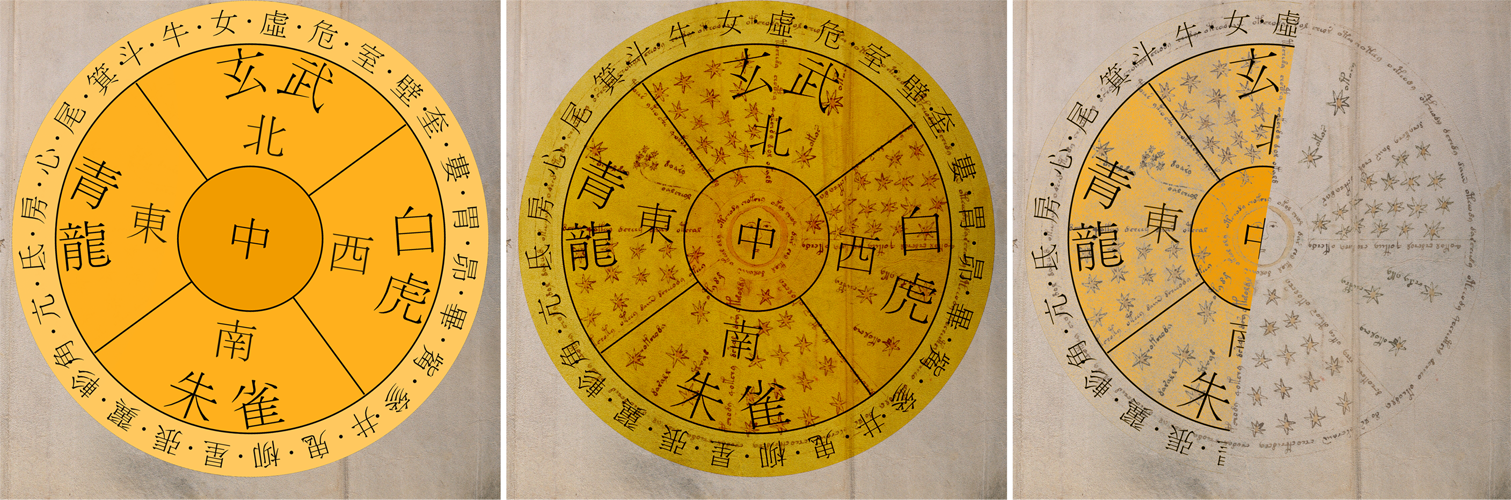
What's more interesting is this rendition of the Mansion System from time of Yuan dynasty 1271-1368. Marco Polo served Yuan dynasty around 1280.
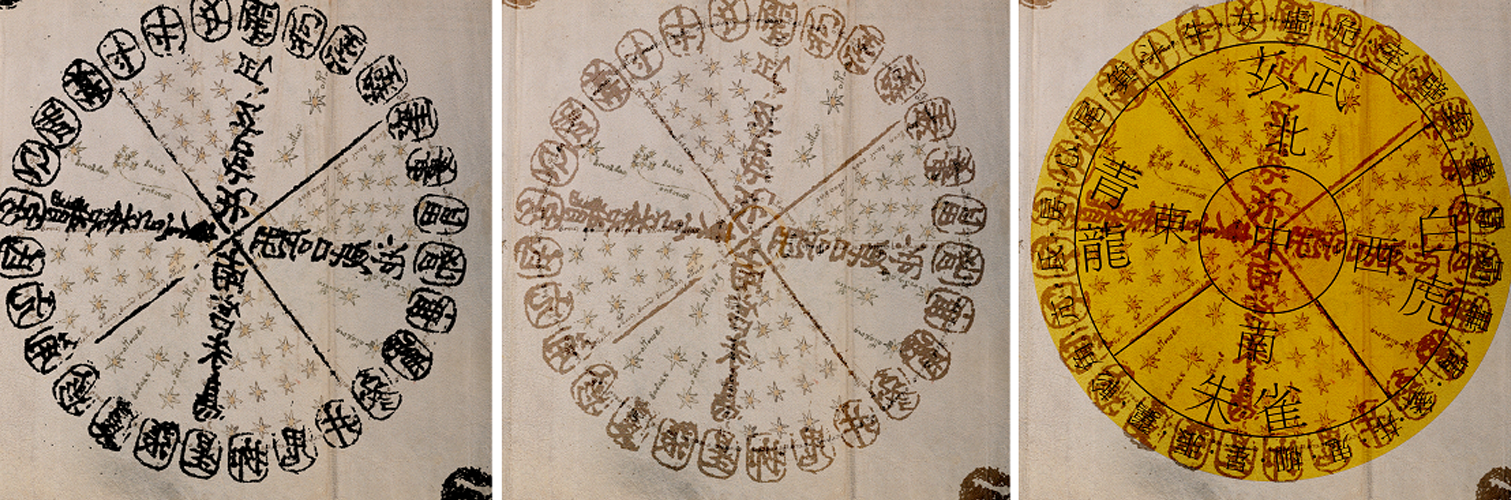
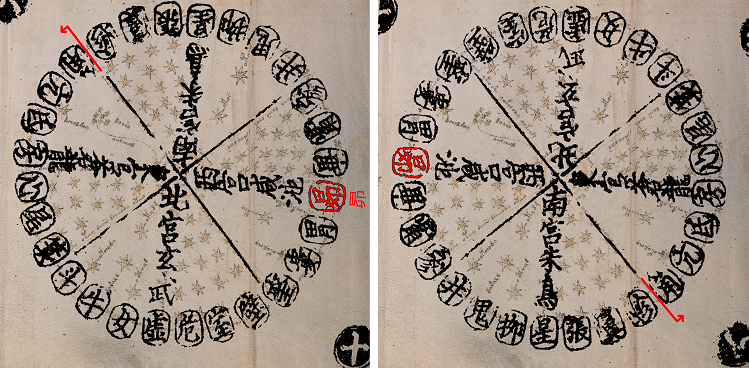
What's important, all lunar mansion systems - be it Arabic, Chinese or Indian - do include Pleiades as one of the mansions. The symbol in Chinese is "昴" is 16th lunar mansion, under Tiger(west).
In this image, I located 昴 on the right and adjusted it to align with the European north-up perspective. Conveniently, the Pleiades constellation in the VMS corresponds to the chart.
edit: changed title from "Chinese Astrology present in VMS" to "Eastern Astrology present in VMS"
|
|
|
|
| A family of grammars for Voynichese |
|
Posted by: Mauro - 27-11-2024, 04:19 PM - Forum: Analysis of the text
- Replies (148)
|
|
Hello everybody. I’m a new member, an Italian with a background in electronics engineering (industrial automation sector, now happily retired). I have dabbled from time to time into the Voynich manuscript, expecially from the point of view of statistics and word structure, without ever finding anything useful to report.
However, I have recently developed a word grammar or, better, a family of grammars, which I would like to share, together with a comparison with the grammars proposed by ThomasCoon, Zattera and Stolfi. Unfortunately, I have not found a way to format the presentation in a good way to display on the forum, so I have uploaded the .pdf file on Google Drive at this link (sorry for the inconvenience):
The contents of the (short) presentation are:
1) INTRODUCTION: mostly concerned in defining how the evaluation of the grammars is made.
2) “BASIC” GRAMMAR: the simplest one, which makes clear how the underlying structure works. It finds 48.7-50.58% of the Voynichese words (depending on the variant of the grammar), with a better efficiency than ThomasCoon and Zattera (efficiency = number of Voynich words found / total words which the grammar can possibly generate).
3) “COMPACT” GRAMMAR: tweaked for efficiency, it’s 3-6 times better than the BASIC grammar, with a small decrease in the words found.
4) “EXTENDED” GRAMMAR: tweaked for coverage, it finds 88.45% of the Voynichese words, while at the same time being simple and reasonably efficient (and the coverage rises to 92.79% if words with ‘rare’ characters such as ‘g’ or ‘v’ etc., which are not used by the grammar, are excluded).
5) APPENDIX: a final consideration and a resume of the data.
Apologizing in advance for any mistakes I may have made, I hope you’ll find it interesting, and I will gladly read any answer and comments from the community.
|
|
|
|
|
![[Image: 9_c9eded69-f84f-4874-833b-0d227403c007.j...width=1200]](https://www.yong-qiu.com/cdn/shop/files/9_c9eded69-f84f-4874-833b-0d227403c007.jpg?v=1688004708&width=1200)
![[Image: size_eb74c4e5-19a7-4a52-a109-d10ed49b7b8...width=1200]](https://www.yong-qiu.com/cdn/shop/files/size_eb74c4e5-19a7-4a52-a109-d10ed49b7b86.jpg?v=1688004661&width=1200)