Posts: 228Threads: 32 Member details
Posts: 228
Threads: 32
Thanks Received: 121 in 83 posts
Thanks Given: 149
Joined: Dec 2016
Reputation:
0
Country: 
(06-06-2022, 02:05 PM)Searcher wrote: You are not allowed to view links. Register or Login to view. (06-06-2022, 01:12 PM)Scarecrow wrote: You are not allowed to view links. Register or Login to view.While talking about verbosity and repetitions (or missing ones), could someone explain these apparent repetitions in this document fragment, in Greek minuscole I believe. As much as I see, it is αλλα ( apocopic αλλ') that means other, else, more.
άλλα:
You are not allowed to view links. Register or Login to view.
Big thanks Searcher. Truly helpful.
Posts: 228Threads: 32 Member details
Posts: 228
Threads: 32
Thanks Received: 121 in 83 posts
Thanks Given: 149
Joined: Dec 2016
Reputation:
0
Country:
(06-06-2022, 02:41 PM)Ruby Novacna wrote: You are not allowed to view links. Register or Login to view.It's triop small, Scarecrown, however, as Searcher says, it can be alla, nothing mysterious. Moreover, this word occurs several times in the text, but it is not repeated several times in a row.
Thanks. It was a mystery to me, but now I am able to follow the bigger picture. Thanks again, and good that there was no more mystery than what we already have here.
Posts: 3,016Threads: 94 Member details
Posts: 3,016
Threads: 94
Thanks Received: 3,810 in 1,793 posts
Thanks Given: 4046
Joined: Jan 2016
Reputation:
7
Location: Italy
Country: 
19-06-2022, 08:02 AM
(This post was last modified: 19-06-2022, 11:40 AM by MarcoP.)
I used a simple simulated-annealing Python script to experiment with verbose ciphers with English as plain-text language. I omitted the rare plain-text characters Q,X,Z. As already discussed, with this approach one has to take liberties with spaces.
This is one of the results for the first lines of f76r:
A -> ['op', 'che', 'oa']
B -> ['cth']
C -> ['in']
D -> ['sh', 'ai']
E -> ['q', 'k', 'r']
F -> ['chk']
G -> ['as']
H -> ['y', 'eo']
I -> ['ain']
J -> ['ee']
K -> ['cph']
L -> ['l', 'or']
M -> ['ol']
N -> ['cho', 'of']
O -> ['chcfh', 'ed', 'chcph']
P -> ['ea']
R -> ['i', 'al']
S -> ['ey', 's']
T -> ['d', 'p', 'chd']
U -> ['ot']
V -> ['am']
W -> ['ok']
Y -> ['ar']
The deciphering of the first line results in a list of actual English word, but things already break down significantly at line two.
Code: tune lot had them to hot had send hath sigh
TUNEL OTH ADTH EMT OH OTH ADS ENDH ATH SI GH
potchokor chcfhdy opshdy qolp chcphy chcphdy opshey qofshy opchdy sain asy
do by at do hem
TDOH EUTTHY BY AT TI WI EWHE DOH EM I DPLSEWJH
dshedy qotddyar cthar chep dain okain qokeor shedy qol ain shealsqokeey
This is the cipher of a short English sentence:
Code: I N TH E
ain chody r
B E G I N N I N G G O D C RE A TE DT H EHE A V EN
cth qasain ofchoain ofasas chcphshin alkopchdr aipeo qykcheam rcho
A N DT H EE A RTH
oaofshdeo qr opaldy
Some thoughts:
- In the absence of grammar, a word salad of a few consecutive words is not significant. Also, a deciphering where the spelling of all longer words requires some tweaking is highly suspicious; in other words, an alternative to searching for perfect matching short words is searching for loosely matching longer words. For instance, the sequence DPLSE at the end of the second line could stand for "DISPLEASE": this is not convincing, e.g. why was the first S dropped and the second one preserved?
- In the absence of grammar, short words are not significant. The probability of randomly getting a longer word is exponentially lower than that of getting short words. Again, longer words matches are only significant if they follow clear rules with no tweaking: these rules may not correspond to modern normalized spelling, e.g. the Latin word "consummatus" may appear as "9sumat9" in a medieval manuscript, the rules mapping the two forms into each other are clear (positional abbreviation symbols and dropping of double consonants).
- Grammar makes a sequence of short words significant: "and if ye go to war in your land" is not the same as "in ye war your land and to go if".
- A verbose cipher does not easily reproduce Voynichese word structure. Probably something like You are not allowed to view links. Register or Login to view. would be needed: each plain-text character needs at least three different encodings corresponding to the three layers of Voynichese words prefix-core-suffix.
Posts: 948Threads: 31 Member details
Posts: 948
Threads: 31
Thanks Received: 349 in 210 posts
Thanks Given: 385
Joined: Apr 2016
Reputation:
5
Country: 
In this case, what we have to do with labels? It will turn out that many of them are two letters words. For example, the word otol consists of the two frequent bigrams, if every of these bigrams stand for one letter, it will be a word of the two letters, the same as otal, okol, okor, okal, okar and many others. So, do we consider them words or something else? If words, they are obviously not English, Latin, German or Italian.
Posts: 3,016Threads: 94 Member details
Posts: 3,016
Threads: 94
Thanks Received: 3,810 in 1,793 posts
Thanks Given: 4046
Joined: Jan 2016
Reputation:
7
Location: Italy
Country:
(19-06-2022, 11:10 AM)Searcher wrote: You are not allowed to view links. Register or Login to view.In this case, what we have to do with labels? It will turn out that many of them are two letters words. For example, the word otol consists of the two frequent bigrams, if every of these bigrams stand for one letter, it will be a word of the two letters, the same as otal, okol, okor, okal, okar and many others. So, do we consider them words or something else? If words, they are obviously not English, Latin, German or Italian.
Hi Yulia, as I wrote You are not allowed to view links. Register or Login to view., I think that labels are a serious problem for the "plain verbose cipher" idea. If it is a verbose cipher, it is likely homophonic and labels suggest that there is more going on (e.g. heavy systematic abbreviation): such a complex system could explain why the manuscript hasn't been decoded yet. Personally I favour other ideas, e.g. an artificial or exotic language, but these have problems too of course.
 The following 1 user says Thank You to MarcoP for this post:1 user says Thank You to MarcoP for this post
• Searcher
Posts: 948Threads: 31 Member details
Posts: 948
Threads: 31
Thanks Received: 349 in 210 posts
Thanks Given: 385
Joined: Apr 2016
Reputation:
5
Country:
Oh, the thought about an artificial language comes to me more and more often. But I'm still not giving up. I still hope that my original idea could be correct, just need to find the right language and the right key. 
Posts: 1,191Threads: 14 Member details
Posts: 1,191
Threads: 14
Thanks Received: 178 in 147 posts
Thanks Given: 331
Joined: Sep 2016
Reputation:
0
Country: 
(19-06-2022, 02:22 PM)MarcoP wrote: You are not allowed to view links. Register or Login to view.e.g. an artificial or exotic language A text in 'exotic' language inlaid with Latin and Greek terms, for example?
Posts: 215Threads: 10 Member details
Posts: 215
Threads: 10
Thanks Received: 111 in 67 posts
Thanks Given: 75
Joined: Dec 2021
Reputation:
0
Location: Spain
(19-06-2022, 02:22 PM)MarcoP wrote: You are not allowed to view links. Register or Login to view.Hi Yulia, as I wrote You are not allowed to view links. Register or Login to view., I think that labels are a serious problem for the "plain verbose cipher" idea. If it is a verbose cipher, it is likely homophonic and labels suggest that there is more going on (e.g. heavy systematic abbreviation): such a complex system could explain why the manuscript hasn't been decoded yet. I agree with this ideas, verbose cipher, homophonic and maybe some abbrevations.
In my opinion "words" are small groups of letters. The iterations of "words" (some of them with slitght variations) throughout the text suggests a style of writting to hide the words. A sample, to say quattor: QTOR ATOR ATTOR.
Posts: 3,016Threads: 94 Member details
Posts: 3,016
Threads: 94
Thanks Received: 3,810 in 1,793 posts
Thanks Given: 4046
Joined: Jan 2016
Reputation:
7
Location: Italy
Country:
21-06-2022, 10:09 AM
(This post was last modified: 21-06-2022, 11:01 AM by MarcoP.)
(20-06-2022, 11:02 AM)Juan_Sali wrote: You are not allowed to view links. Register or Login to view. (19-06-2022, 02:22 PM)MarcoP wrote: You are not allowed to view links. Register or Login to view.Hi Yulia, as I wrote You are not allowed to view links. Register or Login to view., I think that labels are a serious problem for the "plain verbose cipher" idea. If it is a verbose cipher, it is likely homophonic and labels suggest that there is more going on (e.g. heavy systematic abbreviation): such a complex system could explain why the manuscript hasn't been decoded yet. I agree with this ideas, verbose cipher, homophonic and maybe some abbrevations.
In my opinion "words" are small groups of letters.
This is indeed the scenario described in You are not allowed to view links. Register or Login to view.. For instance, the single plain-text word "sigh" is encoded by two Voynichese words 'sain' and 'asy' corresponding to the "small groups of letters" 'si' and 'gh'.
I don't know much about the history of cryptography, but I believe that such a cipher is much more advanced than the actual early XV century ciphers we know.
(20-06-2022, 11:02 AM)Juan_Sali wrote: You are not allowed to view links. Register or Login to view.The iterations of "words" (some of them with slitght variations) throughout the text suggests a style of writting to hide the words. A sample, to say quattor: QTOR ATOR ATTOR.
In the scenario described above, this seems to me to be an over-kill, i.e. further complexity is added without explaining any additional property of Voynichese: - The fact that Voynichese words are short is already explained by the assumption that each cipher-word corresponds to something smaller than a plain-text word. There is no need for an additional abbreviation system (which is instead necessary for a verbose cipher where each cipher-word codes a plain-text word).
- The "slight variations" could be explained by the homophonic options in the verbose cipher: e.g. A could be ciphered as both "ain" or "aiin", B as both 'ok' or 'qok' etc. Features of Voynichese like its low character conditional entropy, almost normal TTR, rigid word structure are not compatible with the arbitrary dropping of characters in your example. Everything is possible, but your example does not seem to me to be consistent with the available evidence.
The following 1 user says Thank You to MarcoP for this post:1 user says Thank You to MarcoP for this post
• Koen G
Posts: 281Threads: 14 Member details
Posts: 281
Threads: 14
Thanks Received: 432 in 186 posts
Thanks Given: 171
Joined: Apr 2021
Reputation:
3
Location: United States
I've recently been looking at a form of writing with characteristics that might be of interest in light of the foregoing conversation, since it's partially verbose and also involves a rigid ordering of glyphs within a "word."
This is Stenotype, a form of machine shorthand in which each syllable is encoded by pressing one or more keys simultaneously ("chording," like playing a chord on a piano). The left hand controls keys for syllable-initial consonants, the thumbs control keys for vowels, and the right hand controls keys for syllable-final consonants. The keyboard looks like this:

You are not allowed to view links. Register or Login to view.
Letters for which single keys aren't provided are encoded by pressing multiple keys at once on the relevant part of the keyboard, which is what makes the system partially verbose. For example, syllable-initial B is PW, syllable-initial N is TPH, short I is EU, long I is AOEU, syllable-final M is PL, and syllable-final J is PBLG. Each key has a vertical column assigned to it on the continuous paper strip the machine spits out, so for each syllable the corresponding letter is either present there or not. The strip advances upward one row each time any keys are struck, and the result (with some abbreviations thrown in) looks like this:
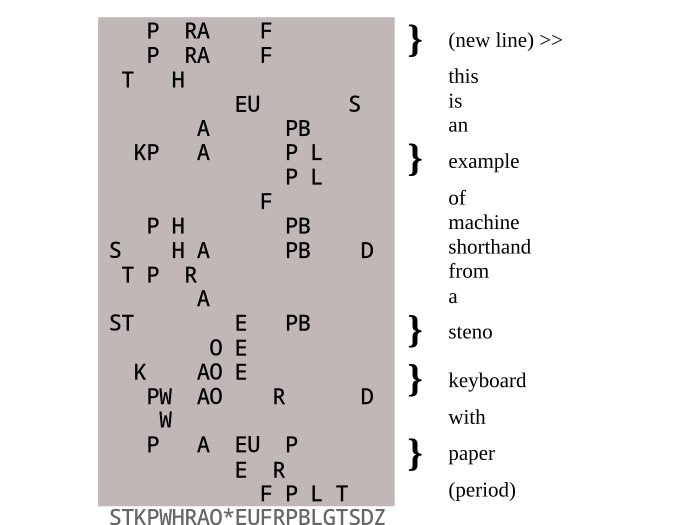
You are not allowed to view links. Register or Login to view.
The asterisk is used in a line by itself to mark a mistake, but it can also be combined with other keys to make additional distinctions, such as F for final F but *F for final V. There's also a number bar at the top of the keyboard that functions like a shift key so that, in connection with it, S types 1, T on the left types 2, P on the left types 3, H types 4, and so on.
Sometimes words or even individual syllables need to be split into multiple lines, depending on the order of the phonemes in them, e.g. PHAR ("Mar") and then FP ("ch") for "March." This situation is variously indicated in training materials, e.g., as PHAR=FP.
Four characters can appear on either the left or the right -- S, T, P, and R -- but every other character can appear only in one designated spot relative to the other characters. On this basis, it seems to me that a Stenotype "word grammar" might look something like a Voynichese one (such as Stolfi's); if anything, it would probably be even simpler. Meanwhile, the reduced character set and predictable order must surely reduce entropy a good deal.
Stenotype conventionally marks the beginning of a paragraph with P*, PF, PRAF, or something similar (depending on the specific system), which means that each paragraph begins with P. Does this remind you of anything in Voynichese? Other punctuation is also encoded by combinations of regular characters, such as PLTD on the right for a period.
I don't want to make too much of all this -- after all, there are plenty of characteristics Voynichese and Stenotype *don't* share in common. But Stenotype seems like an interesting point of comparison nevertheless.
I'm not sure how best to transcribe Stenotype text for statistical analysis, but here's a short specimen with all the left-hand characters capitalized, if anybody cares to experiment with it or expand it (original at You are not allowed to view links. Register or Login to view.):
Quote:PHeu TKer PHR PWRoupb fplt fplt eul Reu u a HReupb or 2 To PHa PHRaeupb PHeu ob fplt euf TPHo PHReu To PHa Tot Pub Kar Ko fplt eu THeu THel f fp PHor TPor PWour Ko pb u PWHRef fplt HRao TH up W Kar fplt TKer PWRo Heul fplt fplt euf ur KWeur f PHa 10 fplt eurb TKo Waeubg Tof Kapb Tat TRaeupb TPor PWuf HRo fplt el Refp THR PWf Wopb fplt el He u PHorpb eu Ko fplt TKer PHR Hafp fplt fplt eu Weurb u Wo Reu PHe WHu HRb Her PWf eu HRef TPor PHeul Wau Ke fplt Hu Reupb PWf THau W Tob Her rbgs eu Wof Tapb ur Peupb up Wour PReupb fplt eul HRao af THa TKa Houfr rbgs apbd l f PHor TPor PWt PWf u Refp Her
|