Posts: 491Threads: 31 Member details
Posts: 491
Threads: 31
Thanks Received: 1,196 in 335 posts
Thanks Given: 24
Joined: Jul 2019
Reputation:
5
Location: Boston, Massachusetts, USA
07-05-2020, 12:23 PM
(This post was last modified: 07-05-2020, 02:53 PM by LisaFaginDavis.)
Well, friends, here it is!
Davis, Lisa Fagin. "How Many Glyphs and How Many Scribes? Digital Paleography and the Voynich Manuscript." [i]Manuscript Studies: A Journal of the Schoenberg Institute for Manuscript Studies[/i] , vol. 5 no. 1, 2020, p. 164-180.
Under normal circumstances, it wouldn't be an open access article, but in the current circumstance Project Muse has made all of their content open access until June 30. So download it while you can!
You are not allowed to view links. Register or Login to view.
I will have a longer piece coming out next year in a volume called Digital Paleography, and I may make small refinements to these conclusions.
Also, something went wrong with the x-axis of figure 2...we ended up with multiple EVA-[f]s there, I'm not sure why. It will be corrected in the Digital Paleography version. But that figure isn't going to tell any of you anything you didn't already know anyway.
I know that some of you will have strong feelings about my work, and I'm happy to have a discussion here about my methodology and conclusions. Enjoy!
![[+]](https://www.voynich.ninja/images/collapse_collapsed.png) The following 18 users say Thank You to LisaFaginDavis for this post:18 users say Thank You to LisaFaginDavis for this post
• MarcoP, RenegadeHealer, Anton, Ruby Novacna, doranchak, Scarecrow, arca_libraria, Common_Man, Alin_J, Emma May Smith, Searcher, Indre, zamolxe, RobGea, DONJCH, nablator, afines, Gab19
The following 18 users say Thank You to LisaFaginDavis for this post:18 users say Thank You to LisaFaginDavis for this post
• MarcoP, RenegadeHealer, Anton, Ruby Novacna, doranchak, Scarecrow, arca_libraria, Common_Man, Alin_J, Emma May Smith, Searcher, Indre, zamolxe, RobGea, DONJCH, nablator, afines, Gab19
Posts: 2,661Threads: 132 Member details
Posts: 2,661
Threads: 132
Thanks Received: 306 in 215 posts
Thanks Given: 254
Joined: May 2016
Reputation:
-3
Country: 
Posts: 4,318Threads: 195 Member details
Posts: 4,318
Threads: 195
Thanks Received: 863 in 621 posts
Thanks Given: 908
Joined: Jun 2015
Reputation:
8
Location: Moscow


Country: 
Hi Lisa,
Having read your article, I have some paleographic questions.
1) When one speaks of different "scribes", does that necessarily mean different persons, or that could mean one and the same person at different stages of his life?
2) Can reasonable guess be made as to whether the scribe was a man or a woman?
3) Was it analysed whether, in folios where there is substantial amount of paragraph text, labels are put down by the same scribe who wrote the main body of the text? In You are not allowed to view links. Register or Login to view. we had a discussion of the interesting situation where the supposed label text looks like written by a different scribe.
4) Is there solid ground to reach conclusions about which scribe is You are not allowed to view links. Register or Login to view. ( aror sheey)?
The following 1 user says Thank You to Anton for this post:1 user says Thank You to Anton for this post
• WhiteVoynich
Posts: 491Threads: 31 Member details
Posts: 491
Threads: 31
Thanks Received: 1,196 in 335 posts
Thanks Given: 24
Joined: Jul 2019
Reputation:
5
Location: Boston, Massachusetts, USA
Thanks, Anton. My answer below:
1) In this case, I believe they are different scribes. There have been studies done exploring how scribe's handwriting changes as they get older, and the differences between "my" Voynich scribes don't suggest that.
2) no
3) One place where I think there MIGHT be a different scribe is the middle on f. 75v, but I haven't made up my mind about this yet. It's definitely a different pen and different batch of ink, but I'm not entirely certain if it's a different scribe.
4) Unfortunately, there just isn't enough Voynichese there to say for sure. I don't THINK it's any of the primary scribes, but I could be wrong.
Posts: 4,318Threads: 195 Member details
Posts: 4,318
Threads: 195
Thanks Received: 863 in 621 posts
Thanks Given: 908
Joined: Jun 2015
Reputation:
8
Location: Moscow
Country:
Thanks!
The point that those are different persons has the important implication. Instead of one person creating a "book of secret knowledge" all in his secrecy, we then have a group of people, and potentially a traveling group (the choice of vellum vs paper, the absence of binding...), sharing and practicing the secret technique of writing... 
Posts: 684Threads: 40 Member details
Posts: 684
Threads: 40
Thanks Received: 428 in 213 posts
Thanks Given: 30
Joined: Jan 2016
Reputation:
3
Location: Germany
Country: 
(07-05-2020, 12:23 PM)LisaFaginDavis wrote: You are not allowed to view links. Register or Login to view.Also, something went wrong with the x-axis of figure 3...we ended up with multiple EVA-[f]s there, I'm not sure why.
Two EVA-[f]s and two EVA-[p]s are not unreasonable. You use v101 by Glen Gaston to transliterate the text. v101 distinguishes between [f] and [u] and in same way between [g] and [j].
The glyphs in the Voynich manuscript occur in a wide variety of shapes. For EVA-[f] and EVA-[p] it is possible to distinguish a variant using a downwardly angled tick and a variant using a straight final quill stroke:

EVA-[fchs]
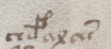
EVA-[chefalas]
Both examples are from folio You are not allowed to view links. Register or Login to view..
Posts: 491Threads: 31 Member details
Posts: 491
Threads: 31
Thanks Received: 1,196 in 335 posts
Thanks Given: 24
Joined: Jul 2019
Reputation:
5
Location: Boston, Massachusetts, USA
(07-05-2020, 03:17 PM)Torsten wrote: You are not allowed to view links. Register or Login to view. (07-05-2020, 12:23 PM)LisaFaginDavis wrote: You are not allowed to view links. Register or Login to view.Also, something went wrong with the x-axis of figure 3...we ended up with multiple EVA-[f]s there, I'm not sure why.
Two EVA-[f]s and two EVA-[p]s are not unreasonable. You use v101 by Glen Gaston to transliterate the text. v101 distinguishes between [f] and [u] and in same way between [g] and [j].
The glyphs in the Voynich manuscript occur in a wide variety of shapes. For EVA-[f] and EVA-[p] it is possible to distinguish a variant using a downwardly angled tick and a variant using a straight final quill stroke:
EVA-[fchs]
EVA-[chefalas]
Both examples are from folio You are not allowed to view links. Register or Login to view..
But that wasn't my intent with that graph. [f] and [p] weren't supposed to be duplicated in the graph.
Posts: 717Threads: 41 Member details
Posts: 717
Threads: 41
Thanks Received: 504 in 288 posts
Thanks Given: 208
Joined: Jan 2016
Reputation:
3
Slightly off-topic: have any colleagues or others in your field noticed this paper today and, if so, how have they received it?
Posts: 491Threads: 31 Member details
Posts: 491
Threads: 31
Thanks Received: 1,196 in 335 posts
Thanks Given: 24
Joined: Jul 2019
Reputation:
5
Location: Boston, Massachusetts, USA
Honestly, most people in my field of manuscript studies won't ever have read anything about the VMS other than what they've seen online and in social media, so they are finding it fascinating and somewhat surprising to learn that the manuscript can in fact be studied using the methodologies of medieval paleography and codicology.
Posts: 684Threads: 40 Member details
Posts: 684
Threads: 40
Thanks Received: 428 in 213 posts
Thanks Given: 30
Joined: Jan 2016
Reputation:
3
Location: Germany
Country:
07-05-2020, 07:32 PM
(This post was last modified: 07-05-2020, 07:33 PM by Torsten.
Edit Reason: typo
)
I have read your inspiring paper. While reading it I stumbled over some questions and would be glad if you would answer them.
The first two questions came already into my mind while watching the You are not allowed to view links. Register or Login to view. with your lecture from the annual meeting of the Bibliographical Society of America. I have postponed this questions since I had hoped to find the answers in your paper.
You say that you initially annotated several different characters, but than decided to focus on v101-[h] (=EVA-[k]). But why did you limited the analysis to just two glyphs? Wouldn't it be helpful to cross check the result by comparing additional glyphs?
Why did you select [h] and [m]/[n] as glyphs for determining different scribes?
How did you handle the large variety of shapes for [h] and [m]/[n] on a single page? Let me give an example to illustrate what I mean. After your criteria Scribe 1 writes [m] and [n] "with a backward flourish that stretches as far as the penultimate minim." But if we expand the section for Scribe 1 in figure 7 (folio 36v) it is also possible to find variants with a short backward stroke, barely passing the final minim:
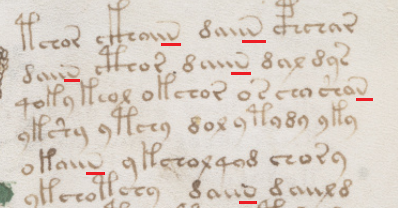 [Part of folio 36v]
Folio 36v as well as folio 99r are both attributed to Scribe 1. But if we compare folio 99r with folio 36v it seems as if [h]-glyphs on folio 99r are written with a larger loop and a more prominent foot than on folio 36v. What would you say to the hypotheses that Scribe 1 was becoming more fluent while writing the (probably newly invented)script?
[Part of folio 36v]
Folio 36v as well as folio 99r are both attributed to Scribe 1. But if we compare folio 99r with folio 36v it seems as if [h]-glyphs on folio 99r are written with a larger loop and a more prominent foot than on folio 36v. What would you say to the hypotheses that Scribe 1 was becoming more fluent while writing the (probably newly invented)script?
 [Part of folio 99r]
You say [h] written by Scribe 3 is similar to that of Scribe 1, although slightly more compact. But didn't that mean that it is not possible to use [h] to distinguish between Scribe 1 and Scribe 3 given that Scribe 3 writes more compact in the first place?
You also say that [h] written by Scribe 4 has a perpendicular crossbar, an oversize loop, and a prominent foot. But if I look on the very first folio attributed to Scribe 4 (folio 67r1) I find it hard to find any [h]-glyph that matches the given description. What have I overlooked?
[Part of folio 99r]
You say [h] written by Scribe 3 is similar to that of Scribe 1, although slightly more compact. But didn't that mean that it is not possible to use [h] to distinguish between Scribe 1 and Scribe 3 given that Scribe 3 writes more compact in the first place?
You also say that [h] written by Scribe 4 has a perpendicular crossbar, an oversize loop, and a prominent foot. But if I look on the very first folio attributed to Scribe 4 (folio 67r1) I find it hard to find any [h]-glyph that matches the given description. What have I overlooked?
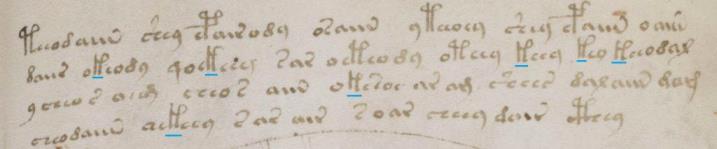 [Top of folio 67r1]
|





