


23-01-2024, 08:52 AM
(This post was last modified: 23-01-2024, 01:02 PM by dfs346.
Edit Reason: reference to v101
)
Many thanks for this clarification. Indeed, we don't need to use the v101 transliteration; we can map directly from the glyphs to Persian letters, as per the proposed mapping. That would be a manual task. The advantage of using v101 as an intermediate step is that the v101 glyphs are available in Unicode, as are the Persian letters. Therefore, using the find-and-replace function in Microsoft Word or Excel, it's a half-hour's work to apply the proposed mapping to a line, a paragraph, a page or even the whole Voynich manuscript.
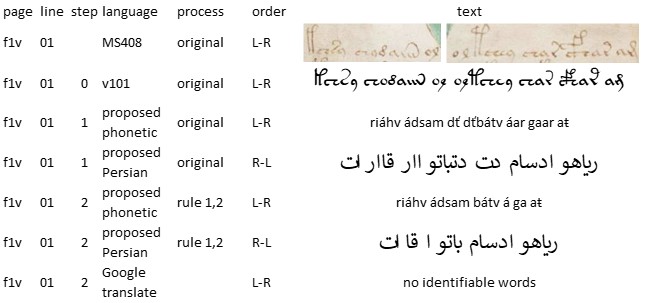
I attempted to apply the proposed mapping, followed by rules 1 and 2, to page You are not allowed to view links. Register or Login to view. line 1. I used Unicode symbols for some of the phonetic strings, to allow the find-and-replace function to work, as follows:
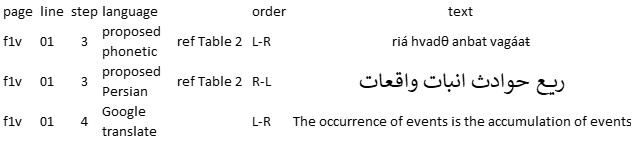
I noted your interpretation (Step 3) and copied it into Google Translate, with the following result:
I understand that Step 3 involves an iterative removal or insertion of spaces in the Voynich text. I guess this is necessarily a subjective process, since the spaces between successive glyphs span a spectrum. Glen Claston's v101 transliteration uses (I think correctly) a distinction between "spaces" and "uncertain spaces"; but even "uncertain spaces" are of varying width. I think the removal and insertion of spaces introduces an arbitrary element into the process.
I would like to invite the comments of this forum on the extent to which Step 3 could be systematised. In other words: could we create a rule for removal or insertion of spaces, that does not rely on a subjective search for specific words?
I attempted to apply the proposed mapping, followed by rules 1 and 2, to page You are not allowed to view links. Register or Login to view. line 1. I used Unicode symbols for some of the phonetic strings, to allow the find-and-replace function to work, as follows:
- all upper case mapped to lower case
- A' mapped to á
- T' mapped to ť
- T" mapped to ŧ
I noted your interpretation (Step 3) and copied it into Google Translate, with the following result:
I understand that Step 3 involves an iterative removal or insertion of spaces in the Voynich text. I guess this is necessarily a subjective process, since the spaces between successive glyphs span a spectrum. Glen Claston's v101 transliteration uses (I think correctly) a distinction between "spaces" and "uncertain spaces"; but even "uncertain spaces" are of varying width. I think the removal and insertion of spaces introduces an arbitrary element into the process.
I would like to invite the comments of this forum on the extent to which Step 3 could be systematised. In other words: could we create a rule for removal or insertion of spaces, that does not rely on a subjective search for specific words?
![[+]](https://www.voynich.ninja/images/collapse_collapsed.png)