Posts: 10,537Threads: 432 Member details
Posts: 10,537
Threads: 432
Thanks Received: 4,933 in 2,808 posts
Thanks Given: 4869
Joined: Mar 2016
Reputation:
11
Country: 
18-06-2021, 07:50 PM
(This post was last modified: 18-06-2021, 08:05 PM by Koen G.)
Hi Lisa, thank you for your interest!
As you read correctly, I am envisioning a particular devotional context. However, these ideas have a peculiar spread geographically. One of the articles that started the whole thing is Dora Salay's “The Eucharistic Man of Sorrows in Late Medieval Art.”. You are not allowed to view links. Register or Login to view.
This map shows an example of the area we're looking at. I did not want to copy it to my post, but here on the forum it should be okay:
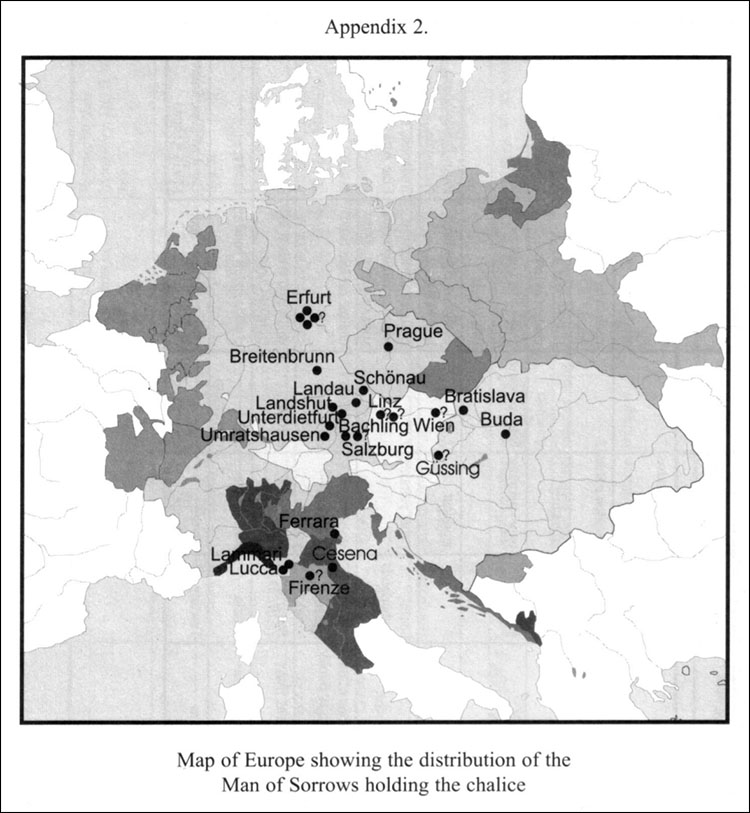 As you can see, this is a remarkable spread for a remarkable form (in this case, the man of sorrows holding the chalice). The area, form northern Italy up to Prague, happens to overlap to a large extent with the area of interest for the VM.
And for example this woodcut is Swiss (though with a date of 1470-1490 it is rather late): You are not allowed to view links. Register or Login to view.
Basically I think the woodcut illustrates in religious terms what Q13 illustrates allegorically as medicinal baths. The clue is that in the VM, the canopy (from which the water originates) is equivalent to the cloud band, which stands for the divine realm.
As you can see, this is a remarkable spread for a remarkable form (in this case, the man of sorrows holding the chalice). The area, form northern Italy up to Prague, happens to overlap to a large extent with the area of interest for the VM.
And for example this woodcut is Swiss (though with a date of 1470-1490 it is rather late): You are not allowed to view links. Register or Login to view.
Basically I think the woodcut illustrates in religious terms what Q13 illustrates allegorically as medicinal baths. The clue is that in the VM, the canopy (from which the water originates) is equivalent to the cloud band, which stands for the divine realm.
Posts: 93Threads: 2 Member details
Posts: 93
Threads: 2
Thanks Received: 183 in 60 posts
Thanks Given: 71
Joined: Dec 2020
Reputation:
1
Country:
Lisa, thank you for the feedback and suggestions! Jeffrey Hamburger is a great recommendation, especially since he discusses one of the devotional images that I mention of a nun bathing in blood at the foot of the cross, which relates to the broader devotional mindset we discuss. I certainly plan to read more from him.
Posts: 2,247Threads: 177 Member details
Posts: 2,247
Threads: 177
Thanks Received: 397 in 324 posts
Thanks Given: 894
Joined: Jan 2016
Reputation:
0
Country: 
One theory does not stand alone. There is too much that is subject to variable interpretation. And that is due, in part, to the intentional creation of visual ambiguity through the alteration of appearance, while maintaining the original identity through other more determinant factors such as position, number and color.
One theory suggesting religious interpretation is supported by another theory with a similar interpretation. For VMs investigation, that would imply the historical Roman Catholic church, focused to the second quarter of the 1400s, with some leeway to either side, particularly to the past for traditional and historical reference.
The tradition of ecclesiastical heraldry is replicated in the red, green or white hats found on certain sets of nymphs in the VMs Zodiac sequence.
Armorial heraldry proposes the historical identification of Pope Innocent IV and reveals a historical connection to the origin of the ecclesiastical tradition of the cardinal's red galero. Why is it hidden in White Aries?
Placement of the two relevant figures in the White Aries depiction accords with their religious ranking.
There is the matter of the VMs critter as a modified version of an Agnus Dei illustration.
And there is the VMs double rainbow, a structure that frequently functions as the throne of Christ in religious images. Here, however, it is empty! Nothing creates ambiguity like an empty throne.
Clearly there is room for religious interpretation of what is found in the VMs, because certain religious elements have been used in the creation of a few illustrations. However, there are also VMs illustrations taken from scientific and classical sources. While the possibility of a 'religious' narrative is easily conceded, clearly it was a religious era (La Sainte Hostie de Dijon, the Colettine Poor Clares), the necessity of such a narrative -any narrative - remains to be demonstrated.
![[+]](https://www.voynich.ninja/images/collapse_collapsed.png) The following 1 user says Thank You to R. Sale for this post:1 user says Thank You to R. Sale for this post
• Pythagoras
The following 1 user says Thank You to R. Sale for this post:1 user says Thank You to R. Sale for this post
• Pythagoras
Posts: 545Threads: 13 Member details
Posts: 545
Threads: 13
Thanks Received: 136 in 100 posts
Thanks Given: 98
Joined: Apr 2018
Reputation:
1
Country: 
Koen I read your article when it was first put up but got interrupted before I could reply.
I reckon you could be on to something there and at the very least it provides a decent unifying model for further research.
Working with Cary is a stroke of genius too. We the viewers look and say "It means this!" or "It means that!" when the whole point is that it means both. That's what artists do. The ambiguity is intentional.
The objection is that this is medieval, but in actual fact the Renaissance started well before the dates usually given.
The following 2 users say Thank You to DONJCH for this post:2 users say Thank You to DONJCH for this post
• Koen G, CaryR
Posts: 10,537Threads: 432 Member details
Posts: 10,537
Threads: 432
Thanks Received: 4,933 in 2,808 posts
Thanks Given: 4869
Joined: Mar 2016
Reputation:
11
Country:
Thanks DONJCH. Yeah, working with Cary was really nice. She's smart and has a talent for finding the exact right articles and pieces of evidence. Also we set out from the very beginning to be critical of each others' ideas, so the collaboration does not become an echo chamber but more like a filter.
Posts: 2,661Threads: 132 Member details
Posts: 2,661
Threads: 132
Thanks Received: 306 in 215 posts
Thanks Given: 254
Joined: May 2016
Reputation:
-3
Country: 
20-06-2021, 12:32 PM
(This post was last modified: 20-06-2021, 04:23 PM by Mark Knowles.)
(18-06-2021, 08:39 AM)Koen G wrote: You are not allowed to view links. Register or Login to view.There are many medieval images where the buildings are part of the backdrop without referring to any specific place.
Could you let me know any examples of such?
(18-06-2021, 08:39 AM)Koen G wrote: You are not allowed to view links. Register or Login to view.
If something like that is the case for these tiny details, then trying to identify them is useless. Similarly, the castle may be a generic castle, not a specific one.
If one looks closely and carefully at the drawings of the buildings what one notices is that very many of them are drawn in a way which makes them distinct and different from one another. Many are not drawn as generic buildings, but rather as specific buildings with their own features. It is true that some of the very smallest buildings are drawn in a way which is quite generic.
Likewise if one compares closely the drawings of each causeway their general shape and features are quite distinct from each other in very significant ways some of which the viewer may not have noticed.
In fact the page is full of specific details.
So, I think, one has to ask what all of these specific details mean.
If all of these specific details are as you suggest, just part of the backdrop without any real meaning, then that means to me that the author put in a lot of effort illustrating those details for them to be absolutely meaningless. And even if they were plucked purely out of the author's imagination then he/she must have had at least some real world reference point.
And if all the details are meaningless why use such a large sheet of vellum to illustrate them when a smaller sheet of vellum would be quite sufficient?
As an extreme example one could operate under the hypothesis that the whole page is meaningless, just the author doodling from his/her imagination. If this is the case then trying to find a meaning from the page is pointless. However I am of the opinion that the page is full of meaning down to some of the very small details.
(18-06-2021, 08:39 AM)Koen G wrote: You are not allowed to view links. Register or Login to view.
What interests me first is the overall structure of the page.
Many of theories of this page focus on the overall structure of the page and one gets the impression that the theorist has probably not even noticed the specific details. I think the ability to explain the details is what really tests a theory of this page. It is easy to come up with a theory which explains the overall structure, it is hard to come up with a theory which explains the very many specifics details. As I say, my biggest concern is that so many people forming theories of the page are not even aware of so many of the specific details of the page. A theory which acknowledges each specific detail even if it does not explain them is progress when compared to so many of the existing theories of the page.
Obviously I have my own very specific ideas about the page, but they don't matter in the context of this general discussion of the page. I, myself, could reproduce so much of the page from memory down to very specific details, excluding the text, I don't think any other Voynich researcher alive or dead could do the same, as I have put a lot of time into studying the page. Because of the time I have spent studying this page I am very conscious of all of the specific details and how many there are.
(18-06-2021, 08:39 AM)Koen G wrote: You are not allowed to view links. Register or Login to view.
Also, I don't think anyone's views should be static.
I completely agree with this statement.
Posts: 2,661Threads: 132 Member details
Posts: 2,661
Threads: 132
Thanks Received: 306 in 215 posts
Thanks Given: 254
Joined: May 2016
Reputation:
-3
Country:
The one rosette which really annoys me is the top left rosette as unlike so much of the page it lacks much specific detail, at least within the circle. Really the only specific detail is the ring of crescent moons, as I describe them, in the centre. That lack of detail leaves it wide open to a lot of different interpretations, which I find frustrating. I think also, to me, it poses the question as to why the author chose to include so little detail; was there little detail to include or was it a conscious decision not to include much detail.
Posts: 2,661Threads: 132 Member details
Posts: 2,661
Threads: 132
Thanks Received: 306 in 215 posts
Thanks Given: 254
Joined: May 2016
Reputation:
-3
Country:
20-06-2021, 02:01 PM
(This post was last modified: 20-06-2021, 02:18 PM by Mark Knowles.)
(18-06-2021, 08:04 PM)CaryR wrote: You are not allowed to view links. Register or Login to view.Lisa, thank you for the feedback and suggestions!
I just wanted to say that your Voynich artwork is amazing.
Posts: 2,606Threads: 121 Member details
Posts: 2,606
Threads: 121
Thanks Received: 1,485 in 941 posts
Thanks Given: 1198
Joined: Mar 2017
Reputation:
6
Location: OWL
Country: 
20-06-2021, 02:36 PM
(This post was last modified: 20-06-2021, 03:56 PM by bi3mw.)
(18-06-2021, 08:04 PM)CaryR wrote: You are not allowed to view links. Register or Login to view.Jeffrey Hamburger is a great recommendation, especially since he discusses one of the devotional images that I mention of a nun bathing in blood at the foot of the cross, which relates to the broader devotional mindset we discuss. I certainly plan to read more from him.
@CaryR: I found a nice article on late medieval liturgical books by Jeffrey Hamburger. It starts from page 74. You can copy the PDF pages into a translator.
BILDERWELTEN, Book Painting between the Middle Ages and Modern Times.
Catalog volume on the exhibitions at the Bavarian State Library from April 13, 2016 to February 24, 2017.
Published by the Bavarian State Library
You are not allowed to view links. Register or Login to view.
edit: I find it interesting that in the early Middle Ages there were separate books for the different parts of the ceremony (Mass) and that these were later combined in a single work (Missale).
Here is another example of such a missal ( Regensburger Missale ):
You are not allowed to view links. Register or Login to view.
The following 2 users say Thank You to bi3mw for this post:2 users say Thank You to bi3mw for this post
• R. Sale, CaryR
Posts: 2,247Threads: 177 Member details
Posts: 2,247
Threads: 177
Thanks Received: 397 in 324 posts
Thanks Given: 894
Joined: Jan 2016
Reputation:
0
Country:
20-06-2021, 05:07 PM
(This post was last modified: 20-06-2021, 05:16 PM by R. Sale.)
The specific / generic dichotomy is problematic because there are examples of both. Generic buildings, cities, etc. are fairly common. Few European artists of the Middle Ages would have had an accurate picture of Constantinople or Jerusalem, let alone Troy. Specifics need to be proven and that is a great difficulty. The devil is in the details and not all examples are equally devious. Places are difficult, either known or nearly impossible to identify. Plant species should be easier to recognize. Ideas and emblems could be the most obvious. Their intent is to convey meaning.
That is the purpose of heraldry. It was a visual code to convey meaning. That is how heraldry was used in the VMs.
Just think: Blue hats and red stripes. Does the combination have any meaning?? <None that I know.>
Then, countercharged. Does the reader recognize the historical connection? Has the potential for meaning been conveyed?
To encode a visual system requires various methods of disguise, various techniques to create ambiguity, the use of heraldic canting. Has the potential for meaning been conveyed?
|




