


One year ago, I posted a similar diagram in You are not allowed to view links. Register or Login to view.. This plot compares words containing 's' and 't' in the lines of Shakespeare's sonnets.
(EDIT: I updated this diagram to make it comparable with the paragraph diagram below)
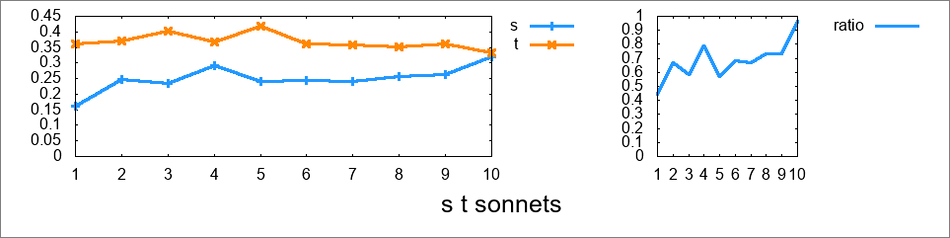
As can be seen, 't' has a rather flat distribution, decreasing at the end of a line, while 's' increases from left to right the end. This could be due to the fact that lines tend to be sentences, and words like 'the','then' and several pronouns ('it', 'they', 'thou') often appear at the beginning of a sentence. The increase for 's' could be due to the suffixes for third person verbs and plural nouns (both of which can appear at the end of sentences).
Cherry-picked examples to illustrate what I mean:
then being asked where all thy beauty lies
the age to come would say this poet lies
they do but sweetly chide thee who confounds
with virtuous wish would bear you living flowers
Treating each sonnet as a paragraph, there could also be some vertical patterns, at least in the last lines:
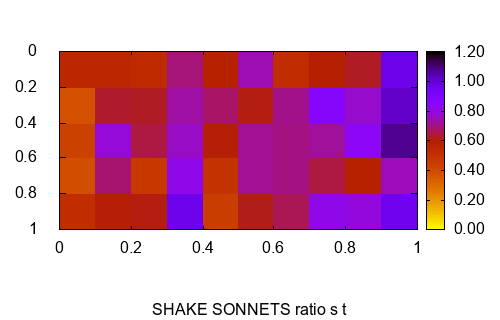
This is a third example (in addition to the ciphers described by Patrick You are not allowed to view links. Register or Login to view.) of something that can cause rightwardness patterns. Of course there are strong reasons that suggest that what we see in Shakespeare's sonnets is different from what we see in Voynichese, but I think it's useful to consider all systems that can cause similar effects: at least, it would be great to find experimental ways to tell one from the others.
About a different side of the topic, I ran a quick and dirty test using Q13 from the You are not allowed to view links. Register or Login to view. that include coordinates for each single words. These are the average X positions for words containing a few patterns. Unless I made errors, this shows that the second member of each couple tends to appear slightly closer to the right margin of the page:
sh 541.4
ch 580.2
ol 595.3
al 638.4
ok 587.9
ot 614.6
(EDIT: I updated this diagram to make it comparable with the paragraph diagram below)
As can be seen, 't' has a rather flat distribution, decreasing at the end of a line, while 's' increases from left to right the end. This could be due to the fact that lines tend to be sentences, and words like 'the','then' and several pronouns ('it', 'they', 'thou') often appear at the beginning of a sentence. The increase for 's' could be due to the suffixes for third person verbs and plural nouns (both of which can appear at the end of sentences).
Cherry-picked examples to illustrate what I mean:
then being asked where all thy beauty lies
the age to come would say this poet lies
they do but sweetly chide thee who confounds
with virtuous wish would bear you living flowers
Treating each sonnet as a paragraph, there could also be some vertical patterns, at least in the last lines:
This is a third example (in addition to the ciphers described by Patrick You are not allowed to view links. Register or Login to view.) of something that can cause rightwardness patterns. Of course there are strong reasons that suggest that what we see in Shakespeare's sonnets is different from what we see in Voynichese, but I think it's useful to consider all systems that can cause similar effects: at least, it would be great to find experimental ways to tell one from the others.
About a different side of the topic, I ran a quick and dirty test using Q13 from the You are not allowed to view links. Register or Login to view. that include coordinates for each single words. These are the average X positions for words containing a few patterns. Unless I made errors, this shows that the second member of each couple tends to appear slightly closer to the right margin of the page:
sh 541.4
ch 580.2
ol 595.3
al 638.4
ok 587.9
ot 614.6
![[+]](https://www.voynich.ninja/images/collapse_collapsed.png)