


09-11-2020, 09:27 AM
Many thanks to Claire and Luke for sharing their work! I agree with what others wrote: the paper presents a great quantity of significant information. The future papers that are mentioned will touch other great subjects, some of which have received very little attention.
I was particularly intrigued by the figure at p.30, where diplomatic and normalized texts are compared. As far as I know, almost nothing has been done in this area. My very limited You are not allowed to view links. Register or Login to view. suggest with a copy of a text by Bonaventura suggested that scribal inconsistency results in a large increase in MATTR values (the same word type can be rendered in several different ways).
I would be grateful if Claire could help me understanding some details about the corpus.
I downloaded the github corpora in order to have a look at MATTR for the historical texts. When looking at the files, I noticed that for the Codex Wormianus and the Necrologium the two files are labelled dip and fac, diplomatic and facsimile, with no "normalized" file.
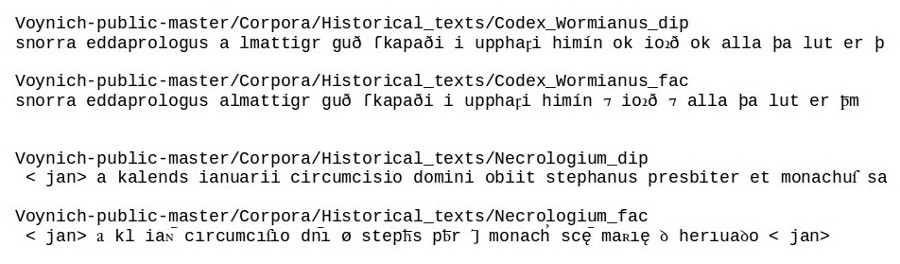
In particular, Necrologium_dip, though based on a smaller character set than Necrologium_fac, uses more characters than the normal Latin alphabet, e.g. the "long-s" is represented by a special character (see "monacus" in the attached image).
I understand that, at p.30, the left Necrologium point corresponds to "dip" and the right point corresponds to "fac". Is it so? Or is the figure based on a normalized file that was not included in the corpus?
Anyway, here are my results for MATTR 50 vs 200. As always, it is possible I made errors along the way.
I added to the samples from the Yale corpus the normalized and diplomatic transcriptions of the Bonaventura text I analysed a while ago.
I was particularly intrigued by the figure at p.30, where diplomatic and normalized texts are compared. As far as I know, almost nothing has been done in this area. My very limited You are not allowed to view links. Register or Login to view. suggest with a copy of a text by Bonaventura suggested that scribal inconsistency results in a large increase in MATTR values (the same word type can be rendered in several different ways).
I would be grateful if Claire could help me understanding some details about the corpus.
I downloaded the github corpora in order to have a look at MATTR for the historical texts. When looking at the files, I noticed that for the Codex Wormianus and the Necrologium the two files are labelled dip and fac, diplomatic and facsimile, with no "normalized" file.
In particular, Necrologium_dip, though based on a smaller character set than Necrologium_fac, uses more characters than the normal Latin alphabet, e.g. the "long-s" is represented by a special character (see "monacus" in the attached image).
I understand that, at p.30, the left Necrologium point corresponds to "dip" and the right point corresponds to "fac". Is it so? Or is the figure based on a normalized file that was not included in the corpus?
Anyway, here are my results for MATTR 50 vs 200. As always, it is possible I made errors along the way.
I added to the samples from the Yale corpus the normalized and diplomatic transcriptions of the Bonaventura text I analysed a while ago.
- For the Latin Necrologium, Secretum and Bonaventura, the abbreviated/diplomatic version has much higher values than the "normalized" transcription
- For the Latin Casebook and the Icelandic Codex the variation is much smaller
- Hebrew with and without vowels also shows a small difference
![[+]](https://www.voynich.ninja/images/collapse_collapsed.png)