


07-09-2020, 08:51 PM
(This post was last modified: 08-09-2020, 07:47 AM by Torsten.
Edit Reason: small change
)
Thank you for sharing the paper. The paper is interesting. But it is also possible to point to some issues.
These are my main findings so far:
1) There is a reference to the paper of Daruka (2020) on page 3 but there is only a comment: "Daruka (2020) likewise comes to the conclusion that the Voynich Manuscript is a hoax and contains gibberish, though created by different means than those suggested by Rugg". By which different means Daruka comes to the same conclusions is not shown or discussed.
2) Daruka (2020) is referencing to arguments presented by Schinner (2007), Timm (2014), Timm (2016) and Timm & Schinner (2020). These arguments are not mentioned and the results presented there are not discussed. This way some important arguments for a structured pseudo-text hypotheses are not discussed.
For instance observations like the unusually random walk results (Schinner 2007), or "the deep correlation between frequency, similarity, and spatial vicinity of tokens" (Timm & Schinner 2020, p.4) are not addressed.
3) Daruka (2020) is referencing to the text generation method presented by Timm (2014) and Timm & Schinner (2020). This text generation method is not mentioned.
4) The paper argues that "gibberish is by nature random" (Bowern & Lindemann 2020, p. 4). There is no reference given for this statement. Moreover, this statement is contradicted by an experiment that is described on p. 5. The result for this experiment is described this way: "It is too easy to make local repetitions and words from other languages." But local repetition is exactly what we see in the Voynich manuscript and it is at least possible to interpret local repetitions as some kind of structure. Moreover this experiment confirms a statement by D'Imperio: "The scribe, faced with the task of thinking up a large number of such dummy sequences, would naturally tend to repeat parts of neighboring strings with various small changes and additions to fill out the line until the next message-bearing word or phrase" (You are not allowed to view links. Register or Login to view. p. 31).
5) The paper argues that the text behaves "non-language like at the character level" but "above the word to line and paragraph, as well as in the distribution of words across the manuscript, it looks like a natural language" (Bowern & Lindemann 2020, p. 4). This two observations contradict each other. The presented conclusion is therefore at least surprising: "This strongly implies that the manuscript is encoded natural language".
6) The paper argues that word tokens can be divided into 'prefixes', 'roots/midfixes', and 'suffixes' (Bowern & Lindemann 2020, p. 11f). This interpretation is contradicted by another observation: characters depend on the previous character. To illustrate the second observation even a table is presented "Frequency of each Voynich Character given the previous character" (Bowern & Lindemann 2020, p. 12). But if a character did depend on a previous character this fact alone explains that glyphs are typical for certain positions. There is no need to for 'prefixes', 'roots/midfixes', and 'suffixes'. The paper also didn't discuss how the assumed affixes behave compared to affixes used in natural languages.
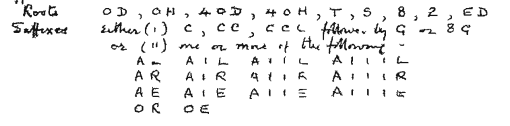
7) The paper names Tiltman (1950) as source for the 'prefixes', 'roots/midfixes', and 'suffixes' hypotheses. But at least in 1967 Tiltman actually did "divide words into what I call 'roots' and 'suffixes'" (Tiltman 1967, p. 7). Moreover Tiltman described glyph sequences like 'ok', and 'qok' as roots and sequences like 'aiin' as suffixes:
8) The paper argues that "the most common word in many natural languages is a definite article like ‘the’, a connective like ‘and’, or a preposition like ‘in’/’of’" (Bowern & Lindemann 2020, p. 14). The paper therefore suggests that <daiin> is a connective (Bowern & Lindemann 2020, p. 14). This is contradicted by the fact that such words are normally equally distributed but that equally distributed words doesn't exist for the Voynich text (see Timm & Schinner 2020, p. 5).
9) The paper argues that Currier A and B did use two different methods to encode natural language or did encode two different languages. Unfortunately the observation that common words used in Currier A like <daiin> also occur frequently in Currier B but not vice versa is not addressed in this context (see Timm & Schinner 2020, p. 7).
10) The paper argues with "Moving average type token ratio" (MATTR) (Bowern & Lindemann 2020, p. 14) and even argues "Voynich most closely resembles the averages for Germanic and Iranian, and least resembles those for Turkic, Dravidian, and Kartvelian". But the paper does not say if the MATTR analyses was done for the whole manuscript or only for Currier A or B. Since the paper argues that Currier A and B did encode language differently it would be important to know what the MATTR-results stand for and if Currier A and B behave differently.
11) The paper argues again "we find Voynich to be well within the expected values for natural language texts, and far from random gibberish" (Bowern & Lindemann 2020, p. 16). Unfortunately, nobody argues that the text represents random gibberish.
12) On page 17 the line and the paragraph are discussed as functional units. The paper suggests that the words are ordered or that the "same word will be written differently depending on where it appears in the line" (Bowern & Lindemann 2020, p. 17). There is no discussion if such patterns could be observed in natural languages as well (they doesn't behave this way).
13) The paper argues on p. 19 the "repetitiveness is at least partly the result of the relatively limited set of character combinations and the predictable structure of Voynich words". A deeper analyses of this phenomenon can be found in Timm & Schinner 2020. But this paper is not mentioned.
14) On p. 18f the paper discusses "phrases" but didn't mention the fact that longer repeated word sequences are missing. The paper of Akinori Ito from 2002 "Observation of left and right entropy in Voynich MS" argues: "This result suggests that words in VMS are quite context-independent." A similar result was presented by Cárdenas et. al. in 2014. The paper with the title "Does network complexity help organize Babel’s library?" argues: "It can be observed that the distributions of these 'randomized texts' are similar to those of the originals, which implies that inhomogeneous distribution of connectivity depends not on the way words are linked, but rather on the frequency of words in the text". The results of both papers are highly relevant for the question if phrases exists but they are not mentioned or discussed. Instead the paper only refers to a single pattern found by Currier in 1976: "A word that begins with qo- is usually preceded by a word that ends with -y" (Bowern & Lindemann 2020, p. 19). But this pattern occurs on character level and not on word level.
15) The paper argues that the word type <aiin> "is usually preceded by a short one or two-letter word (e.g. ar aiin, or aiin, s aiin). The paper suggests that "short words may represent articles or prepositions" (Bowern & Lindemann 2020, p. 19). No concrete numbers are given. I have counted 20 instances of 'ar aiin', 47 instances of 'or aiin' and 30 instances of 's aiin'. The pattern behind this observation is that words occur together if at the same time both word build also a commonly used word (see Timm 2015, p. 23). A word <araiin> is indeed used 10 times, the word <olaiin> occurs 52 times and the word <saiin> occurs 144 times.
16) The paper argues "we would expect ok- to be feminine singular, ot- to be masculine singular, op- to be feminine plural, and of- to be masculine plural." (Bowern & Lindemann 2020, p. 19). This directly contradicts the three part structure presented earlier. Now the paper assumes a two part structure as suggested by Tiltman. Moreover, earlier in the paper gallows are seen as part of the 'root/midfix' now it is assumed that Gallows are used as prefixes.
17) The paper argues "We do find certain constraints on what can follow gallows characters. For example, p/f p/f are never followed by e" (Bowern & Lindemann 2020, p. 19). But words like <shefeeedy> on folio 48v or <qopeeedar> on folio 50r are only extremely rare (see You are not allowed to view links. Register or Login to view.).
18) The paper argues "pages that are nearest neighbors in topic modeling tend to be adjacent to one another in the manuscript" and concludes the text is "inconsistent with a hoax" (Bowern & Lindemann 2020, p. 20). An explanation for this observation is given in Timm & Schinner 2020 on page 7: "Now, reordering the sections with respect to the frequency of token <chedy> replaces the seemingly irregular mixture of two separate languages by the gradual evolution of a single system from 'state A' to 'state B'". The alternative explanation is not addressed.
19) The paper concludes "The higher structure of the manuscript itself is completely consistent with natural language" (Bowern & Lindemann 2020, p. 23). The paper only discusses some patterns on character level and that the text is structured in some way. Then the paper tries to explain the patterns found as evidence for the natural language hypotheses. But the paper did not discuss the patterns that are missing. Typical for some kind of morphological structure are relations between different word classes, a set of grammatical rules, sentence structures or the existence of common phrases. Such patterns are not addressed.
In the end the paper argues that since the text is structured in some way and since some kind of context dependency exists that the text is "far from random gibberish". This is basically the same argumentation as in You are not allowed to view links. Register or Login to view.. But "simply because the VM has some structure, even one that resembles language in some ways, does not entail that it is likely to have a genuine linguistic structure" (You are not allowed to view links. Register or Login to view.).
These are my main findings so far:
1) There is a reference to the paper of Daruka (2020) on page 3 but there is only a comment: "Daruka (2020) likewise comes to the conclusion that the Voynich Manuscript is a hoax and contains gibberish, though created by different means than those suggested by Rugg". By which different means Daruka comes to the same conclusions is not shown or discussed.
2) Daruka (2020) is referencing to arguments presented by Schinner (2007), Timm (2014), Timm (2016) and Timm & Schinner (2020). These arguments are not mentioned and the results presented there are not discussed. This way some important arguments for a structured pseudo-text hypotheses are not discussed.
For instance observations like the unusually random walk results (Schinner 2007), or "the deep correlation between frequency, similarity, and spatial vicinity of tokens" (Timm & Schinner 2020, p.4) are not addressed.
3) Daruka (2020) is referencing to the text generation method presented by Timm (2014) and Timm & Schinner (2020). This text generation method is not mentioned.
4) The paper argues that "gibberish is by nature random" (Bowern & Lindemann 2020, p. 4). There is no reference given for this statement. Moreover, this statement is contradicted by an experiment that is described on p. 5. The result for this experiment is described this way: "It is too easy to make local repetitions and words from other languages." But local repetition is exactly what we see in the Voynich manuscript and it is at least possible to interpret local repetitions as some kind of structure. Moreover this experiment confirms a statement by D'Imperio: "The scribe, faced with the task of thinking up a large number of such dummy sequences, would naturally tend to repeat parts of neighboring strings with various small changes and additions to fill out the line until the next message-bearing word or phrase" (You are not allowed to view links. Register or Login to view. p. 31).
5) The paper argues that the text behaves "non-language like at the character level" but "above the word to line and paragraph, as well as in the distribution of words across the manuscript, it looks like a natural language" (Bowern & Lindemann 2020, p. 4). This two observations contradict each other. The presented conclusion is therefore at least surprising: "This strongly implies that the manuscript is encoded natural language".
6) The paper argues that word tokens can be divided into 'prefixes', 'roots/midfixes', and 'suffixes' (Bowern & Lindemann 2020, p. 11f). This interpretation is contradicted by another observation: characters depend on the previous character. To illustrate the second observation even a table is presented "Frequency of each Voynich Character given the previous character" (Bowern & Lindemann 2020, p. 12). But if a character did depend on a previous character this fact alone explains that glyphs are typical for certain positions. There is no need to for 'prefixes', 'roots/midfixes', and 'suffixes'. The paper also didn't discuss how the assumed affixes behave compared to affixes used in natural languages.
7) The paper names Tiltman (1950) as source for the 'prefixes', 'roots/midfixes', and 'suffixes' hypotheses. But at least in 1967 Tiltman actually did "divide words into what I call 'roots' and 'suffixes'" (Tiltman 1967, p. 7). Moreover Tiltman described glyph sequences like 'ok', and 'qok' as roots and sequences like 'aiin' as suffixes:
8) The paper argues that "the most common word in many natural languages is a definite article like ‘the’, a connective like ‘and’, or a preposition like ‘in’/’of’" (Bowern & Lindemann 2020, p. 14). The paper therefore suggests that <daiin> is a connective (Bowern & Lindemann 2020, p. 14). This is contradicted by the fact that such words are normally equally distributed but that equally distributed words doesn't exist for the Voynich text (see Timm & Schinner 2020, p. 5).
9) The paper argues that Currier A and B did use two different methods to encode natural language or did encode two different languages. Unfortunately the observation that common words used in Currier A like <daiin> also occur frequently in Currier B but not vice versa is not addressed in this context (see Timm & Schinner 2020, p. 7).
10) The paper argues with "Moving average type token ratio" (MATTR) (Bowern & Lindemann 2020, p. 14) and even argues "Voynich most closely resembles the averages for Germanic and Iranian, and least resembles those for Turkic, Dravidian, and Kartvelian". But the paper does not say if the MATTR analyses was done for the whole manuscript or only for Currier A or B. Since the paper argues that Currier A and B did encode language differently it would be important to know what the MATTR-results stand for and if Currier A and B behave differently.
11) The paper argues again "we find Voynich to be well within the expected values for natural language texts, and far from random gibberish" (Bowern & Lindemann 2020, p. 16). Unfortunately, nobody argues that the text represents random gibberish.
12) On page 17 the line and the paragraph are discussed as functional units. The paper suggests that the words are ordered or that the "same word will be written differently depending on where it appears in the line" (Bowern & Lindemann 2020, p. 17). There is no discussion if such patterns could be observed in natural languages as well (they doesn't behave this way).
13) The paper argues on p. 19 the "repetitiveness is at least partly the result of the relatively limited set of character combinations and the predictable structure of Voynich words". A deeper analyses of this phenomenon can be found in Timm & Schinner 2020. But this paper is not mentioned.
14) On p. 18f the paper discusses "phrases" but didn't mention the fact that longer repeated word sequences are missing. The paper of Akinori Ito from 2002 "Observation of left and right entropy in Voynich MS" argues: "This result suggests that words in VMS are quite context-independent." A similar result was presented by Cárdenas et. al. in 2014. The paper with the title "Does network complexity help organize Babel’s library?" argues: "It can be observed that the distributions of these 'randomized texts' are similar to those of the originals, which implies that inhomogeneous distribution of connectivity depends not on the way words are linked, but rather on the frequency of words in the text". The results of both papers are highly relevant for the question if phrases exists but they are not mentioned or discussed. Instead the paper only refers to a single pattern found by Currier in 1976: "A word that begins with qo- is usually preceded by a word that ends with -y" (Bowern & Lindemann 2020, p. 19). But this pattern occurs on character level and not on word level.
15) The paper argues that the word type <aiin> "is usually preceded by a short one or two-letter word (e.g. ar aiin, or aiin, s aiin). The paper suggests that "short words may represent articles or prepositions" (Bowern & Lindemann 2020, p. 19). No concrete numbers are given. I have counted 20 instances of 'ar aiin', 47 instances of 'or aiin' and 30 instances of 's aiin'. The pattern behind this observation is that words occur together if at the same time both word build also a commonly used word (see Timm 2015, p. 23). A word <araiin> is indeed used 10 times, the word <olaiin> occurs 52 times and the word <saiin> occurs 144 times.
16) The paper argues "we would expect ok- to be feminine singular, ot- to be masculine singular, op- to be feminine plural, and of- to be masculine plural." (Bowern & Lindemann 2020, p. 19). This directly contradicts the three part structure presented earlier. Now the paper assumes a two part structure as suggested by Tiltman. Moreover, earlier in the paper gallows are seen as part of the 'root/midfix' now it is assumed that Gallows are used as prefixes.
17) The paper argues "We do find certain constraints on what can follow gallows characters. For example, p/f p/f are never followed by e" (Bowern & Lindemann 2020, p. 19). But words like <shefeeedy> on folio 48v or <qopeeedar> on folio 50r are only extremely rare (see You are not allowed to view links. Register or Login to view.).
18) The paper argues "pages that are nearest neighbors in topic modeling tend to be adjacent to one another in the manuscript" and concludes the text is "inconsistent with a hoax" (Bowern & Lindemann 2020, p. 20). An explanation for this observation is given in Timm & Schinner 2020 on page 7: "Now, reordering the sections with respect to the frequency of token <chedy> replaces the seemingly irregular mixture of two separate languages by the gradual evolution of a single system from 'state A' to 'state B'". The alternative explanation is not addressed.
19) The paper concludes "The higher structure of the manuscript itself is completely consistent with natural language" (Bowern & Lindemann 2020, p. 23). The paper only discusses some patterns on character level and that the text is structured in some way. Then the paper tries to explain the patterns found as evidence for the natural language hypotheses. But the paper did not discuss the patterns that are missing. Typical for some kind of morphological structure are relations between different word classes, a set of grammatical rules, sentence structures or the existence of common phrases. Such patterns are not addressed.
In the end the paper argues that since the text is structured in some way and since some kind of context dependency exists that the text is "far from random gibberish". This is basically the same argumentation as in You are not allowed to view links. Register or Login to view.. But "simply because the VM has some structure, even one that resembles language in some ways, does not entail that it is likely to have a genuine linguistic structure" (You are not allowed to view links. Register or Login to view.).
![[+]](https://www.voynich.ninja/images/collapse_collapsed.png)