





19-10-2019, 09:39 AM
(This post was last modified: 19-10-2019, 09:57 AM by -JKP-.
Edit Reason: fixed typos
)
Thank you, Marco. I very much appreciate you taking time to summarize the talk.
Wow. I confess to being surprised at Touwaide's various descriptions of the plants. I know this is supposed to be one of Touwaide's areas of expertise but... I don't know what to say.
For example:
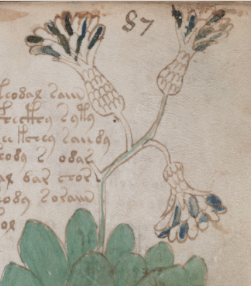 The structures at the top are not poppy-like at all. I think it's off-base to compare these flower heads to hard seed capsules. Poppy seed-pods are very distinctive and the petals (which are attached at the base, not at the top) drop off, so they do not look like this. The VMS flower-heads are like asters (see Centaurea) and are very very common, including the scaly patterns. You can see examples here:
You are not allowed to view links. Register or Login to view.
You are not allowed to view links. Register or Login to view.
Many plants in the aster family have rosette-arranged leaves, so there's a good chance that the VMS plant is from the aster family. I don't think there's any possibility that it is from the poppy family (and I think it is misleading to compare the shape of a flower calyx to a poppy capsule).
It's not a good idea to call these capsules, even when talking casually. Those are part of the flower calyx. The term "capsule" usually refers to the seed capsule which develops as the petals are falling away (or are completely gone). But... this has gone from French to Italian to English and it's easy for this kind of term to change in translation, so don't take this as a criticism, but rather as an observation. I know how hard it is to transfer terms through several languages.
I'm not sure why Touwaide mentions "emoji-like" tiny faces in You are not allowed to view links. Register or Login to view. . In medieval iconography, a dot inside a pod or stamen or other similar structure usually refers to pollen or seeds and I think it's more important to mention this than what is probably a coincidental resemblance to faces. In fact, one of them as three "eyes" which does not seem like a reference to faces.
I think this is an incorrect assessment. This is not a combination plant. This is quite a good drawing of a plant from the Villarsia/Menyanthes family and the flower is pretty accurate (probably Nymphoides or frogbit group).
---
I'm very familiar with LJS 62. I've gone through it many times.
I'm not sure why Touwaide would consider this more similar to the VMS than others. There aren't a lot of plant drawings (only 10 folios) and they are similar to many herbal manuscripts. The snakes next to the roots in 8v are found in many manuscripts and are drawn with cross-hatching that was in style in late 15th-century and later. There's nothing especially remarkable about the drawings and unlike the VMS, most of the roots are quite simple and naturalistic. The leaves are naturalistic also. They do not look like they are mnemonic or symbolic. They're more similar to early 16th-century drawings than they are to older ones (or to the VMS).
As for the dating of the LJS 62...
I've learned to date Gothic Latin script fairly well, usually within a couple of decades, but I am not particularly good at dating Greek text. I can only narrow it down within about 100 or 200 years for some of them. So I cannot comment on when the main text was written (if I were forced to guess I would guess maybe late 15th century or 16th century, but I would not be confident about it).
However, I have gotten reasonably good at numbers—I've studied them extensively. The numbers in the contents and the foliation are mostly likely later than the 16th century (or possibly from the latter half of the 16th century, but I'm leaning toward 17th century. They may have been added sometime after the main text. Some of the ones on the back leaf look like they are even later (maybe as late as 19th or 20th century).
So, it's my belief that LJS 62 was created some time after the VMS, perhaps by about a century and I honestly don't find them that similar, at least not when other herbal manuscripts are included in the comparison
Just looking at it overall, I would be surprised if LJS 62 were earlier than 1480 and it might be up to 50 years later than that.
So, I do not think LJS 62 is early enough or similar enough to compare to the VMS (especially when so many manuscripts are more similar). I'm surprised he chose it as an example.
I hate writing responses like this. I had high hopes for learning something from Touwaide. I am disappointed. He might be an expert in his respective field, but his understanding of the VMS seems to me to be superficial.
Wow. I confess to being surprised at Touwaide's various descriptions of the plants. I know this is supposed to be one of Touwaide's areas of expertise but... I don't know what to say.
For example:
Touwaide Summary - wrote: You are not allowed to view links. Register or Login to view. shows different motifs:
- rosette-like leaves (repeated twice)
- poppy-like globular structures at the top
You are not allowed to view links. Register or Login to view.
You are not allowed to view links. Register or Login to view.
Many plants in the aster family have rosette-arranged leaves, so there's a good chance that the VMS plant is from the aster family. I don't think there's any possibility that it is from the poppy family (and I think it is misleading to compare the shape of a flower calyx to a poppy capsule).
Touwaide Summary - wrote:The poppy-like capsules are combined with a sun-like flower in VMS You are not allowed to view links. Register or Login to view. and with emoji-like tiny "faces" in You are not allowed to view links. Register or Login to view.
It's not a good idea to call these capsules, even when talking casually. Those are part of the flower calyx. The term "capsule" usually refers to the seed capsule which develops as the petals are falling away (or are completely gone). But... this has gone from French to Italian to English and it's easy for this kind of term to change in translation, so don't take this as a criticism, but rather as an observation. I know how hard it is to transfer terms through several languages.
I'm not sure why Touwaide mentions "emoji-like" tiny faces in You are not allowed to view links. Register or Login to view. . In medieval iconography, a dot inside a pod or stamen or other similar structure usually refers to pollen or seeds and I think it's more important to mention this than what is probably a coincidental resemblance to faces. In fact, one of them as three "eyes" which does not seem like a reference to faces.
Touwaide Summary - wrote:* You are not allowed to view links. Register or Login to view. appears to combine nymphaea and lily
I think this is an incorrect assessment. This is not a combination plant. This is quite a good drawing of a plant from the Villarsia/Menyanthes family and the flower is pretty accurate (probably Nymphoides or frogbit group).
---
Touwaide Summary - wrote:A medical manuscript that could be partly comparable with the Voynich herbal is You are not allowed to view links. Register or Login to view.. The library dates it to the XV Century, but it could be much later, XVII or XVIII Century.
I'm very familiar with LJS 62. I've gone through it many times.
I'm not sure why Touwaide would consider this more similar to the VMS than others. There aren't a lot of plant drawings (only 10 folios) and they are similar to many herbal manuscripts. The snakes next to the roots in 8v are found in many manuscripts and are drawn with cross-hatching that was in style in late 15th-century and later. There's nothing especially remarkable about the drawings and unlike the VMS, most of the roots are quite simple and naturalistic. The leaves are naturalistic also. They do not look like they are mnemonic or symbolic. They're more similar to early 16th-century drawings than they are to older ones (or to the VMS).
As for the dating of the LJS 62...
I've learned to date Gothic Latin script fairly well, usually within a couple of decades, but I am not particularly good at dating Greek text. I can only narrow it down within about 100 or 200 years for some of them. So I cannot comment on when the main text was written (if I were forced to guess I would guess maybe late 15th century or 16th century, but I would not be confident about it).
However, I have gotten reasonably good at numbers—I've studied them extensively. The numbers in the contents and the foliation are mostly likely later than the 16th century (or possibly from the latter half of the 16th century, but I'm leaning toward 17th century. They may have been added sometime after the main text. Some of the ones on the back leaf look like they are even later (maybe as late as 19th or 20th century).
So, it's my belief that LJS 62 was created some time after the VMS, perhaps by about a century and I honestly don't find them that similar, at least not when other herbal manuscripts are included in the comparison
Just looking at it overall, I would be surprised if LJS 62 were earlier than 1480 and it might be up to 50 years later than that.
So, I do not think LJS 62 is early enough or similar enough to compare to the VMS (especially when so many manuscripts are more similar). I'm surprised he chose it as an example.
I hate writing responses like this. I had high hopes for learning something from Touwaide. I am disappointed. He might be an expert in his respective field, but his understanding of the VMS seems to me to be superficial.