Posts: 2,766Threads: 27 Member details
Posts: 2,766
Threads: 27
Thanks Received: 892 in 623 posts
Thanks Given: 894
Joined: May 2025
Reputation:
0
Location: Campinas (SP), Brazil
Country: 
(10-10-2025, 01:17 PM)Koen G wrote: You are not allowed to view links. Register or Login to view.In my view, it is worthwhile to study rare characters as rare characters. This means looking at their context (when are they used, when not?)...
But one must be aware that many of those weirdos are just "accidents" where the Scribe intended to write one of the common characters but it came out malformed to the point of being unrecognizable.
And I will not even mention retracing, not at all. (What the hell is that?)
All the best, --jorge
Posts: 2,661Threads: 132 Member details
Posts: 2,661
Threads: 132
Thanks Received: 306 in 215 posts
Thanks Given: 254
Joined: May 2016
Reputation:
-3
Country: 
10-10-2025, 01:59 PM
(This post was last modified: 10-10-2025, 02:02 PM by Mark Knowles.)
(10-10-2025, 01:47 PM)Jorge_Stolfi wrote: You are not allowed to view links. Register or Login to view. (10-10-2025, 01:17 PM)Koen G wrote: You are not allowed to view links. Register or Login to view.In my view, it is worthwhile to study rare characters as rare characters. This means looking at their context (when are they used, when not?)...
But one must be aware that many of those weirdos are just "accidents" where the Scribe intended to write one of the common characters but it came out malformed to the point of being unrecognizable.
And I will not even mention retracing, not at all. (What the hell is that?)
All the best, --jorge
I think some are certainly accidents, but I think the argument needs to be advanced in every case. Clearly when a "weirdo" appears only in one place in the whole manuscript it may be, although not necessarily is, an accident. Where a glyph appears more than once in different places in the manuscript one should be wary of dismissing it as an accident unless one has a good argument for doing so. And one should certainly not dismiss characters that one recognises as geninue, purely on the basis that they occur rarely. If the author(s) chose to draw a glyph there is a reason for it and so it needs to be taken seriously. I think it is also a mistake to dismiss characters that typically, but not universally, appear in certain places. I think one has to be cautious in identifying certain "spaces" as spaces when sometimes this is not certain.
Posts: 2,766Threads: 27 Member details
Posts: 2,766
Threads: 27
Thanks Received: 892 in 623 posts
Thanks Given: 894
Joined: May 2025
Reputation:
0
Location: Campinas (SP), Brazil
Country:
(10-10-2025, 01:59 PM)Mark Knowles wrote: You are not allowed to view links. Register or Login to view.Where a glyph appears more than once in different places in the manuscript one should be wary of dismissing it as an accident unless one has a good argument for doing so
Yes, of course. There are some weirdos that are very rare but almost certainly not accidents, like v, x, and the other strange symbols in the 4x17 sequence.
But other weirdos, even frequent ones, may just be accidents. Like b, u, g, which may be just "accidental" versions of n, an, m, or whatever.
All the best, --jorge
Posts: 2,661Threads: 132 Member details
Posts: 2,661
Threads: 132
Thanks Received: 306 in 215 posts
Thanks Given: 254
Joined: May 2016
Reputation:
-3
Country:
(10-10-2025, 02:21 PM)Jorge_Stolfi wrote: You are not allowed to view links. Register or Login to view. (10-10-2025, 01:59 PM)Mark Knowles wrote: You are not allowed to view links. Register or Login to view.Where a glyph appears more than once in different places in the manuscript one should be wary of dismissing it as an accident unless one has a good argument for doing so
Yes, of course. There are some weirdos that are very rare but almost certainly not accidents, like v, x, and the other strange symbols in the 4x17 sequence.
But other weirdos, even frequent ones, may just be accidents. Like b, u, g, which may be just "accidental" versions of n, an, m, or whatever.
All the best, --jorge
Yes, I agree. One has to be careful and rigorous. In each case one needs to list every instance of a symbol in the manuscript and how similar it is to a known symbol and so how likely it is to be an accident or error. In my studies I have seen symbols that I was not previously aware of. Symbols should not be ignored or dismissed without a good argument to justify that. I am of the view that the Voynich manuscript likely has a large number of glyphs with specific substitutions, but then I look it through the lens of diplomatic ciphers of the time where there were sometimes many glyphs with specific substitutions.
Posts: 378Threads: 8 Member details
Posts: 378
Threads: 8
Thanks Received: 185 in 129 posts
Thanks Given: 1046
Joined: Nov 2024
Reputation:
1
Location: Italy
(09-10-2025, 10:05 PM)Mark Knowles wrote: You are not allowed to view links. Register or Login to view.I recently decided to read through the whole manuscript and make digital annotations. My chief focus has been on words with distinctive spelling. It is my observation that words with more distinctive spelling and less common glyphs are often ignored by researchers. I think this is a big mistake.
I agree that most of the research has been done on frequent words while rare readings have been overlooked, and it's surely possible that the rare readings are what is actually important. But there are also reasons for concentrating on frequent combinations: rare things make bad statistics or, to see it another way, they are noisy and difficult to work with. Scribal errors, retracing errors (if there was actually a retracer), ambiguity of handwritten characters, transcription errors... they're all big problems when rare glyph groups are concerned.
![[+]](https://www.voynich.ninja/images/collapse_collapsed.png) The following 1 user says Thank You to Mauro for this post:1 user says Thank You to Mauro for this post
• Koen G
The following 1 user says Thank You to Mauro for this post:1 user says Thank You to Mauro for this post
• Koen G
Posts: 4,493Threads: 170 Member details
Posts: 4,493
Threads: 170
Thanks Received: 3,319 in 1,868 posts
Thanks Given: 579
Joined: Jan 2016
Reputation:
10
Country: 
When Gabriel and I did our transliteration around 1999-2000, we noted all unusual characters and variants and gave them a number. Completely independently, GC did the same exercise a few years later.
The overlap between the two sets is remarkably good.
They are compared in detail in You are not allowed to view links. Register or Login to view., with all the counts, so there is quantitative information for people who are interested in this.
Note that the character set of the RF transliteration was deliberately reduced before it was created as a combination of the other two.
Posts: 2,773Threads: 13 Member details
Posts: 2,773
Threads: 13
Thanks Received: 582 in 455 posts
Thanks Given: 85
Joined: Sep 2019
Reputation:
2
Location: Zürich / Schweiz
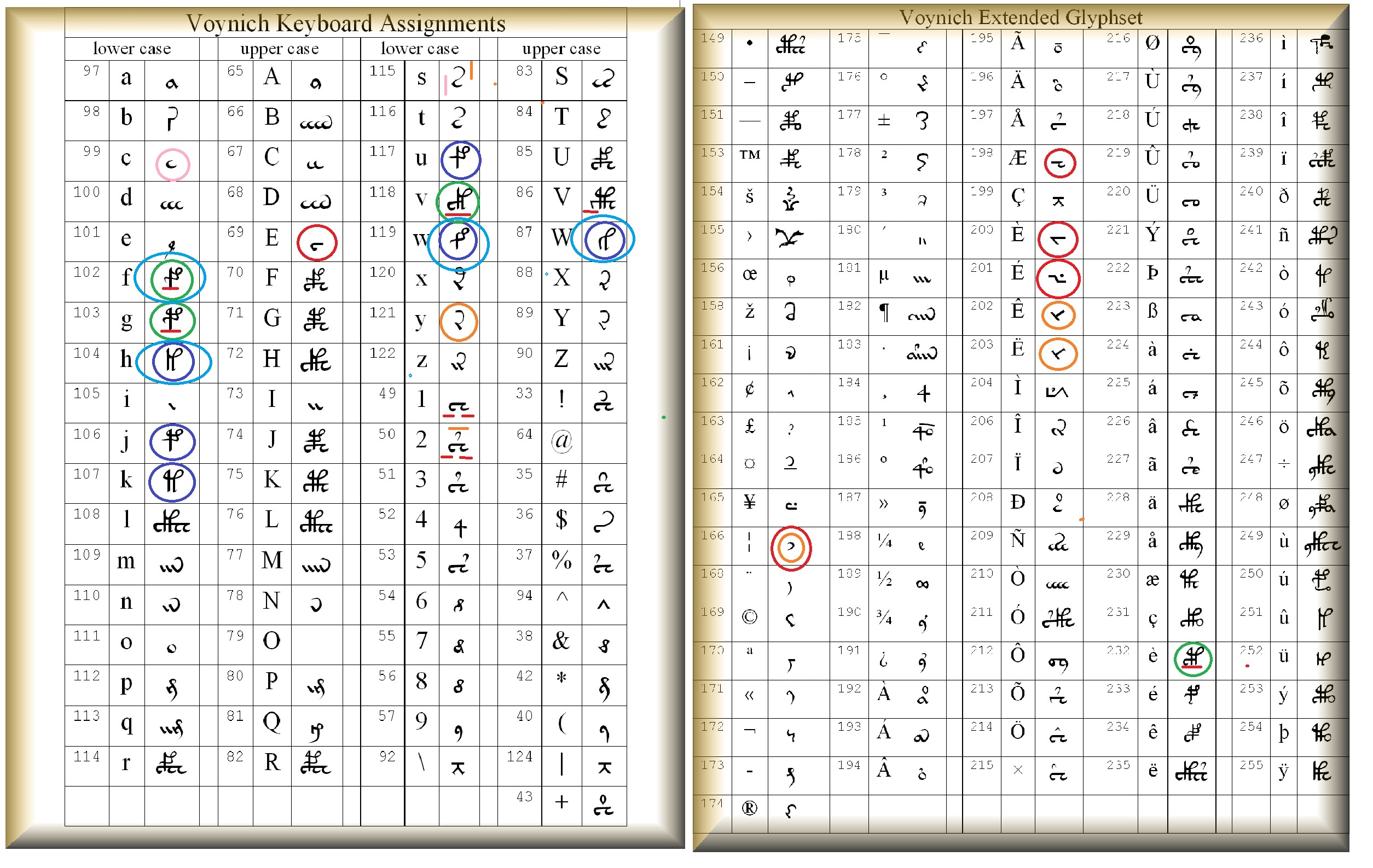
I'm just going to follow on from Rene's work here.
If you look at the whole thing at a glance, everything repeats itself.
Example: Dark blue are single glyphs, red are combination glyphs, and green is the result.
I can connect everything together, so everything looks the same, but it isn't.
It is a combination system. Simple but efficient.
Example: ASCII 99 + 166 = 115.
Problem: Every writer can put words together however they want, and then it becomes an endless glyph.
Someday I'll write a combination, if I feel like it.
|






