





14-11-2026, 04:26 AM
I am not sure how you see poppy and nightshade? Which is which and which plants are you thinking about in particular? I guess you think You are not allowed to view links. Register or Login to view. is the poppy? Not sure, I guess they both have some similarities insofar as big seed pods, but so do many other plants. I don't see any leaves or petals that remind me of poppy, nor nightshades for that matter.
I think You are not allowed to view links. Register or Login to view. is Licebane, now known as Staphisagria macrosperma, formerly Delphinium staphisagria, and staphis agria in antiquity (Dioscorides). I think the vms drawing includes a reference to lice in the root, it is reminiscent of a side view of a louse, and includes the claws on the ends of their appendages. The bubbly cutoff on the root mimics the lobes of the louse body.


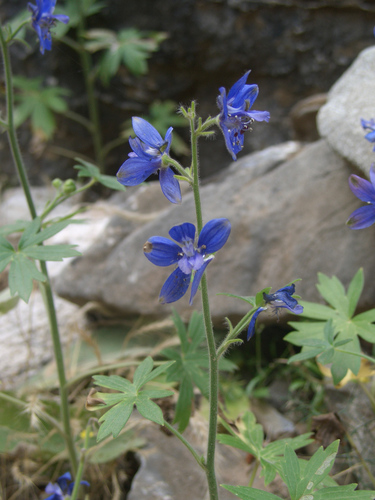

From wiki:
The genus name Staphisagria and the common name stavesacre come from the Ancient Greek name mentioned by Dioscorides, σταφὶς ἀγρία (staphis agria, "wild raisin").[6] Dioscorides described the plant as having wild grape vine-like leaves, but Barton and Castle considered the name as an allusion to the large wrinkled brown seeds.[7] This name derivation by Barton and Castle seems to have been arrived at independently by a modern horticulturalist, David Bassett, who also gives a detailed account of his experiences in growing this species.[8]
Ancient Greeks also called the plant φθειροκτόνον (phthiroctonon, "louse killer") because of its use in traditional medicine to kill lice.[6] This meaning is retained in many of the plant's common names in different languages,[7] such as lice-bane in English, matapiojos in Spanish, bit otu in Turkish.
The plant doesn't have a root that looks like a louse, but the whole plant including the seeds and roots is toxic, often crushed into a powder to get rid of various types of lice. The seed pod endss also remind of the louse claws.
I guess if you were going for poisons, this one might be notable. They say the practice has stopped because you could poison yourself instead of the lice.
33r reminds me of Silene vulgaris. It is the opposite of being poisonous.


The leaves do not grow as drawn, they clasp the stem at a node, which could be why they are drawn as they are, if they were removed from the plant, as they are, for eating. The leaves as drawn could represent their foraged look on the plate, as it is a well known edible. (Collejas, Sculpit, Stridoli, Strigoli...)
You can kind of see this here at about 11 oclock and also 2 o clock, nearer the middle, the underside of the leaf sticking up makes two slightly longer edges. Sometimes some of the stem "skin" comes off with it to make it even longer. These ones here are longer and thinner than usual but I had trouble finding a better example that still showed leaf shape.


5 split petals look to the naked eye like 10, sometimes they curl up as well so could present like the spiral drawing.


I guess the green one is closest to what is drawn, I get various colours where I am in Canada, here it is a naturalized roadside weed but I grow it on purpose in my garden because it is an edimental. (Perrenial Edible ornamental). I think the dots and lines in the green area on You are not allowed to view links. Register or Login to view. approximate the design of the calyx quite well. The dark green petals as drawn I have not seen, but sometimes they are light pink, fuschia or variegated instead of white.
The roots can be used to wash hair, (high in saponins)(cooking removes any traces from the leaves). I think that is what the roots are saying here.
I can't see why a poppy or a nightshade would be seen that way, can you give an example of what exactly you see?
I think You are not allowed to view links. Register or Login to view. is Licebane, now known as Staphisagria macrosperma, formerly Delphinium staphisagria, and staphis agria in antiquity (Dioscorides). I think the vms drawing includes a reference to lice in the root, it is reminiscent of a side view of a louse, and includes the claws on the ends of their appendages. The bubbly cutoff on the root mimics the lobes of the louse body.
From wiki:
The genus name Staphisagria and the common name stavesacre come from the Ancient Greek name mentioned by Dioscorides, σταφὶς ἀγρία (staphis agria, "wild raisin").[6] Dioscorides described the plant as having wild grape vine-like leaves, but Barton and Castle considered the name as an allusion to the large wrinkled brown seeds.[7] This name derivation by Barton and Castle seems to have been arrived at independently by a modern horticulturalist, David Bassett, who also gives a detailed account of his experiences in growing this species.[8]
Ancient Greeks also called the plant φθειροκτόνον (phthiroctonon, "louse killer") because of its use in traditional medicine to kill lice.[6] This meaning is retained in many of the plant's common names in different languages,[7] such as lice-bane in English, matapiojos in Spanish, bit otu in Turkish.
The plant doesn't have a root that looks like a louse, but the whole plant including the seeds and roots is toxic, often crushed into a powder to get rid of various types of lice. The seed pod endss also remind of the louse claws.
I guess if you were going for poisons, this one might be notable. They say the practice has stopped because you could poison yourself instead of the lice.
33r reminds me of Silene vulgaris. It is the opposite of being poisonous.
The leaves do not grow as drawn, they clasp the stem at a node, which could be why they are drawn as they are, if they were removed from the plant, as they are, for eating. The leaves as drawn could represent their foraged look on the plate, as it is a well known edible. (Collejas, Sculpit, Stridoli, Strigoli...)
You can kind of see this here at about 11 oclock and also 2 o clock, nearer the middle, the underside of the leaf sticking up makes two slightly longer edges. Sometimes some of the stem "skin" comes off with it to make it even longer. These ones here are longer and thinner than usual but I had trouble finding a better example that still showed leaf shape.
5 split petals look to the naked eye like 10, sometimes they curl up as well so could present like the spiral drawing.
I guess the green one is closest to what is drawn, I get various colours where I am in Canada, here it is a naturalized roadside weed but I grow it on purpose in my garden because it is an edimental. (Perrenial Edible ornamental). I think the dots and lines in the green area on You are not allowed to view links. Register or Login to view. approximate the design of the calyx quite well. The dark green petals as drawn I have not seen, but sometimes they are light pink, fuschia or variegated instead of white.
The roots can be used to wash hair, (high in saponins)(cooking removes any traces from the leaves). I think that is what the roots are saying here.
I can't see why a poppy or a nightshade would be seen that way, can you give an example of what exactly you see?