


I haven’t read the paper yet, but on the basis of Patrick’s research the question could be, is it that aiin follows ‘or’, or(sorry) is the phenomenon better described as ‘a’ follows ‘r’?
I may have made errors, but my check suggests that the top 7 most frequent a- words in the manuscript are the same as the top 7 most frequent a- words that appear immediately after ‘or’.
aiin, ar, al, ain, am, air, aiiin
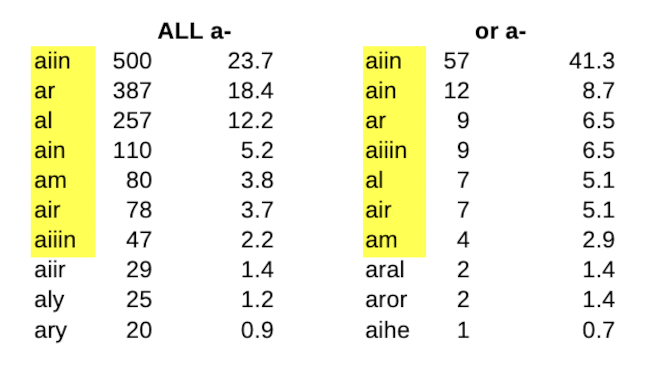
It doesn’t seem that ‘or’ is “selecting” ‘aiin’ in particular.
In general, Voynichese words that are similar tend to behave similarly. We discussed it extensively for You are not allowed to view links. Register or Login to view., but it's a widespread phenomenon.
This doesn't happen with 'pink' 'think' 'ink' (nor with 'pink' 'pin' 'pined')
But it’s not just about single glyphs, like: ‘r’ tends to be followed by ‘a’. You are not allowed to view links. Register or Login to view. has shown that the dependency is not limited to the immediately preceding glyph, so ‘or’ will trigger different following glyphs than generic ‘r’.
Patrick analysis is not limited to word boundaries, so this can also be observed in word structure:
In Patrick’s words:
I may have made errors, but my check suggests that the top 7 most frequent a- words in the manuscript are the same as the top 7 most frequent a- words that appear immediately after ‘or’.
aiin, ar, al, ain, am, air, aiiin
It doesn’t seem that ‘or’ is “selecting” ‘aiin’ in particular.
In general, Voynichese words that are similar tend to behave similarly. We discussed it extensively for You are not allowed to view links. Register or Login to view., but it's a widespread phenomenon.
This doesn't happen with 'pink' 'think' 'ink' (nor with 'pink' 'pin' 'pined')
But it’s not just about single glyphs, like: ‘r’ tends to be followed by ‘a’. You are not allowed to view links. Register or Login to view. has shown that the dependency is not limited to the immediately preceding glyph, so ‘or’ will trigger different following glyphs than generic ‘r’.
Patrick analysis is not limited to word boundaries, so this can also be observed in word structure:
- d is typically followed by y
- But eeed is almost always followed by y
- While yd is more frequently followed by a
In Patrick’s words:
Quote:Voynichese is encoded continuously in a way consistent with transitional probability matrices, but glyphs can sometimes affect transitions beyond the ones that follow immediately after them.
![[+]](https://www.voynich.ninja/images/collapse_collapsed.png)