


Lisa and Colin, as I’ve expressed to you before, I think this is really great work, both technically and substantively!
There is one aspect that I’m wondering how you explain—although it does not really detract from the plausibility of the rest of your hypothesized explanation of the book’s original collation.
When we look at the separate sheets unbound from the codex—most of which are single bifolios, although some are larger foldouts, such as trifolios and even seven-panel foldouts—it makes sense that they may have been composed independently of their eventual ordering within the bound sequence.
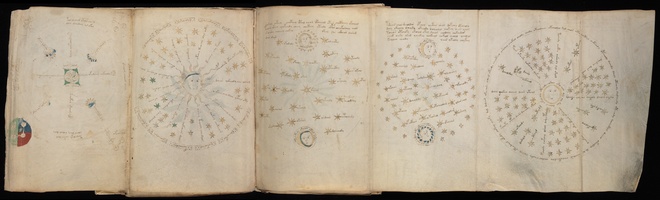
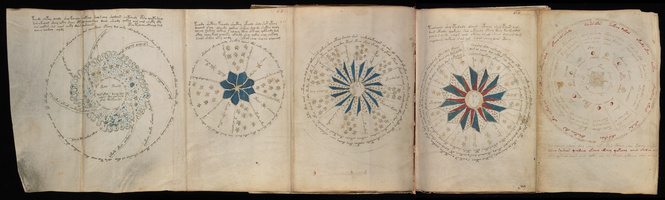
A good example is the recto and verso sides of the single vellum sheet that forms Quire 9. We can perceive visual similarities among all the panels on a given side, in contrast with those on the opposite side. That grouping of similar diagrams is broken up in the page sequence of the bound version—and I know there are even better examples than this.
Recto
Verso
But if the full sheets were created with the intention of standing alone, how do we explain Quire 14—folios 85 and 86—which consists of the large six-panel sheet? The reverse side of the sheet, opposite the large rosette drawing, contains individual page panels, some of which consist entirely of Voynichese script.
It seems to have been created with the intention of being bound, given that some of the text panels contain script in opposing orientations—that is, upside down relative to one another.
Regards,
Andrew
There is one aspect that I’m wondering how you explain—although it does not really detract from the plausibility of the rest of your hypothesized explanation of the book’s original collation.
When we look at the separate sheets unbound from the codex—most of which are single bifolios, although some are larger foldouts, such as trifolios and even seven-panel foldouts—it makes sense that they may have been composed independently of their eventual ordering within the bound sequence.
A good example is the recto and verso sides of the single vellum sheet that forms Quire 9. We can perceive visual similarities among all the panels on a given side, in contrast with those on the opposite side. That grouping of similar diagrams is broken up in the page sequence of the bound version—and I know there are even better examples than this.
Recto
Verso
But if the full sheets were created with the intention of standing alone, how do we explain Quire 14—folios 85 and 86—which consists of the large six-panel sheet? The reverse side of the sheet, opposite the large rosette drawing, contains individual page panels, some of which consist entirely of Voynichese script.
It seems to have been created with the intention of being bound, given that some of the text panels contain script in opposing orientations—that is, upside down relative to one another.
Regards,
Andrew
![[+]](https://www.voynich.ninja/images/collapse_collapsed.png)