


11-07-2026, 01:36 PM
(This post was last modified: 11-07-2026, 01:39 PM by LisaFaginDavis.)
That's not really an important part of this particular work, but I have written an entire chapter in our forthcoming book that treats the question of the material history of the manuscript. Here's the sequence I propose:
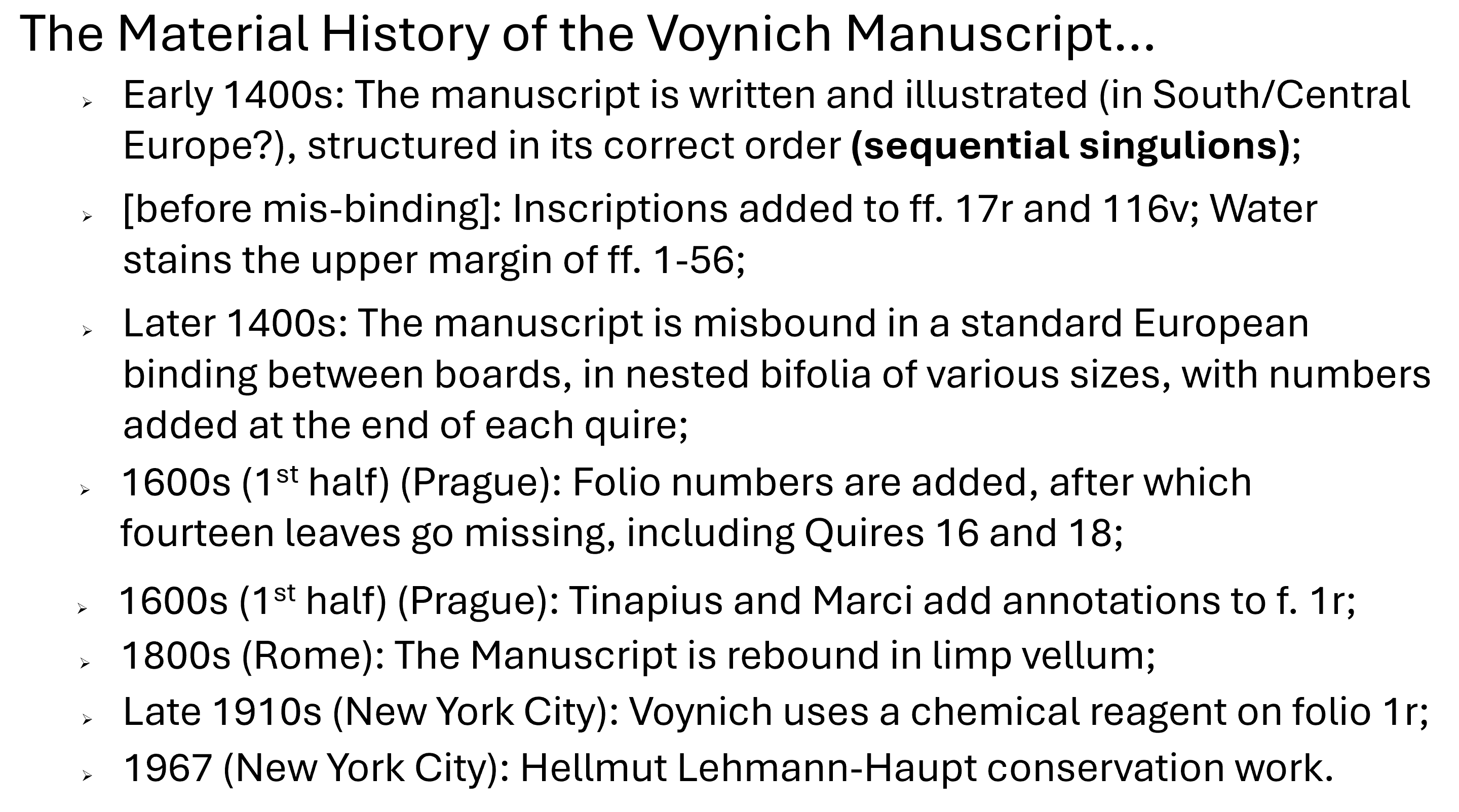
In order to prepare the nested bifoliate quires for binding, the numbers would have been added to the last verso of each quire, so that the binder would know what to do. For Quire 9, I suspect that whomever did the nesting and preparation wrote the number in the correct place and binder sewed the wrong valley-fold (or they changed their mind and sewed through that fold intentionally).
We should be grateful to the mysterious mis-binder, since if the manuscript hadn't been protected by being sewn together and attached to wooden boards, it would almost certainly not have survived.
Regarding the covers: there is a difference between the sewing, which is original (except for the later repairs, which don't impact the sequence of bifolia), and the boards to which the quires are attached via the perpendicular cords at the spine. The wooden boards were replaced by the Jesuits with the current limp vellum in the nineteenth century without conducting a new quire-sewing campaign.
A lecture I gave on this topic at the University of Toronto last year is online here:
You are not allowed to view links. Register or Login to view.
Some of the conclusions in the Singulion article differ from what I present about the data analytics in that lecture, because the work was ongoing. The Digital Medievalist article represents the latest work.
In order to prepare the nested bifoliate quires for binding, the numbers would have been added to the last verso of each quire, so that the binder would know what to do. For Quire 9, I suspect that whomever did the nesting and preparation wrote the number in the correct place and binder sewed the wrong valley-fold (or they changed their mind and sewed through that fold intentionally).
We should be grateful to the mysterious mis-binder, since if the manuscript hadn't been protected by being sewn together and attached to wooden boards, it would almost certainly not have survived.
Regarding the covers: there is a difference between the sewing, which is original (except for the later repairs, which don't impact the sequence of bifolia), and the boards to which the quires are attached via the perpendicular cords at the spine. The wooden boards were replaced by the Jesuits with the current limp vellum in the nineteenth century without conducting a new quire-sewing campaign.
A lecture I gave on this topic at the University of Toronto last year is online here:
You are not allowed to view links. Register or Login to view.
Some of the conclusions in the Singulion article differ from what I present about the data analytics in that lecture, because the work was ongoing. The Digital Medievalist article represents the latest work.
![[+]](https://www.voynich.ninja/images/collapse_collapsed.png)