


A few comments about the image You are not allowed to view links. Register or Login to view.. The image is part of You are not allowed to view links. Register or Login to view., a hausbuch / housebook written around 1450. Here I processed the image to increase contrast:
The manuscript includes a collection of medical and astrological works, as well as a treaty about geomantic divination. Similar contents can be found in the Tubingen Hausbuch (Md 2).
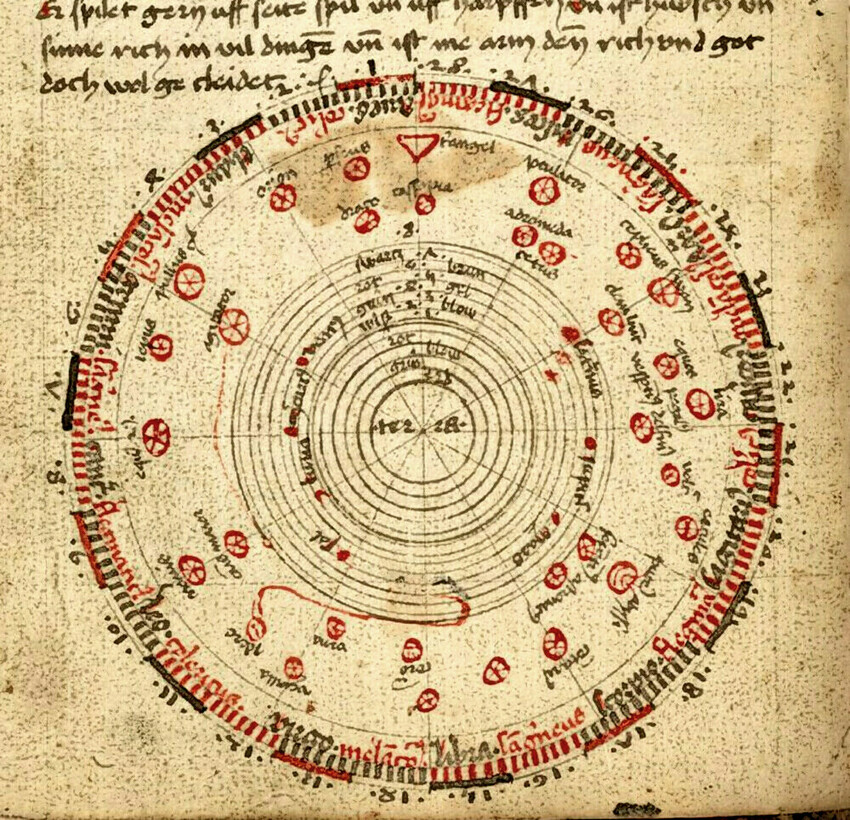
The diagram posted by Koen represents the constellations and appears at the end of a section where each constellation is individually illustrated and described. The center of the diagram is labelled “terra” (earth). The next four circles for the elements are only labelled with German color annotations for the corresponding colors (that were never painted). I cannot read the first one, the other three are grun=green (water), blau=blue (air), rot=red (fire). Then there are circles for the seven planets, again with color annotations. A much wider circle represents the constellations and the outer circle is marked with the zodiac signs (in counterclockwise order) EDIT: the corresponding Galenic humours and numbers for the 28 lunar mansions.
In the diagram, the constellations are (mostly) marked by a small circle with an asterisk inscribed into it. They are labelled in Latin. Both Northern (e.g. Draco, Cassiopea, near the top) and Southern constellations are included. The constellations are arranged according to the zodiac signs which appear on the outer circle.
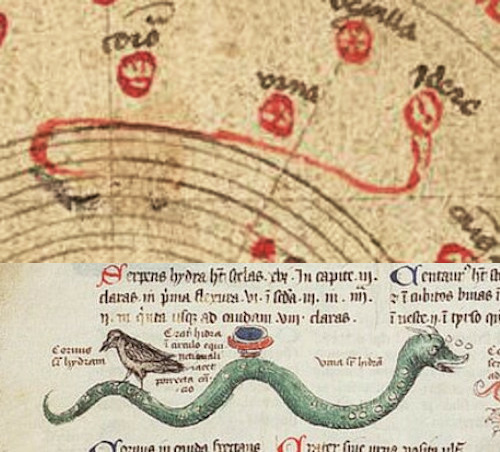
The “wavy line” at the bottom of the diagram represents the Southern constellation Hydra (labelled “Idere”); the label was written next to a snake’s head that appears here instead of the usual asterisk. Next to the middle of Hydra’s body, there’s a constellation labelled “urna” (jar) corresponding to Crater. Another nearby constellation is labelled something like "coroum"[?] (it could be "corvus", the crow). (bottom image from You are not allowed to view links. Register or Login to view.).
On the left side, another fainter line starts from the Auriga constellation (here labelled with the frequent alternative name “agitator”) and is almost parallel to the inner circle. This is harder to interpret: I guess it could represent the Milky Way, but I am not aware of illustrations where it was drawn.
The Tubingen Hausbuch also includes diagrams of the constellations arranged according to the zodiac (also here shown counterclockwise). The constellations are split into two different circles for You are not allowed to view links. Register or Login to view. and You are not allowed to view links. Register or Login to view., and are fully illustrated by the usual figures.
The manuscript includes a collection of medical and astrological works, as well as a treaty about geomantic divination. Similar contents can be found in the Tubingen Hausbuch (Md 2).
The diagram posted by Koen represents the constellations and appears at the end of a section where each constellation is individually illustrated and described. The center of the diagram is labelled “terra” (earth). The next four circles for the elements are only labelled with German color annotations for the corresponding colors (that were never painted). I cannot read the first one, the other three are grun=green (water), blau=blue (air), rot=red (fire). Then there are circles for the seven planets, again with color annotations. A much wider circle represents the constellations and the outer circle is marked with the zodiac signs (in counterclockwise order) EDIT: the corresponding Galenic humours and numbers for the 28 lunar mansions.
In the diagram, the constellations are (mostly) marked by a small circle with an asterisk inscribed into it. They are labelled in Latin. Both Northern (e.g. Draco, Cassiopea, near the top) and Southern constellations are included. The constellations are arranged according to the zodiac signs which appear on the outer circle.
The “wavy line” at the bottom of the diagram represents the Southern constellation Hydra (labelled “Idere”); the label was written next to a snake’s head that appears here instead of the usual asterisk. Next to the middle of Hydra’s body, there’s a constellation labelled “urna” (jar) corresponding to Crater. Another nearby constellation is labelled something like "coroum"[?] (it could be "corvus", the crow). (bottom image from You are not allowed to view links. Register or Login to view.).
On the left side, another fainter line starts from the Auriga constellation (here labelled with the frequent alternative name “agitator”) and is almost parallel to the inner circle. This is harder to interpret: I guess it could represent the Milky Way, but I am not aware of illustrations where it was drawn.
The Tubingen Hausbuch also includes diagrams of the constellations arranged according to the zodiac (also here shown counterclockwise). The constellations are split into two different circles for You are not allowed to view links. Register or Login to view. and You are not allowed to view links. Register or Login to view., and are fully illustrated by the usual figures.
![[+]](https://www.voynich.ninja/images/collapse_collapsed.png)