


Back in January 2017, I discussed You are not allowed to view links. Register or Login to view. the idea that the wave line in You are not allowed to view links. Register or Login to view. could correspond to the eclipse dragon. That discussion was partly based on an Indian astrological painting. It has often been suggested that the seven stars in the Voynich diagram could be the Pleiades. The wave line connects the seven start with the moon which appears at the centre.
While search manuscripts to include in the 116v I am doing with Koen, I stumbled upon a source that provides a geographically closer parallel to that idea: the work discussed in this paper by Isabelle Draelants: You are not allowed to view links. Register or Login to view., 2021.
The work contains many illustration, mostly rotae i.e. circular astronomical diagrams. Surviving illustrated copies:
The text appears to be very interesting, but what stroke me is a particular diagram (in particular in the Vatican ms) where a snake is shown between the moon (represented by a crescent) and a label for Pleiades (Pliades). The text says that the Pleiades are moon's enemies and eclipses of the moon are caused by "the dragon of the Pleiades".
This is the illustration from the Vatican manuscript: (f.10v). The numbers and small circles on the diameter of the rota represent the mansions of the moon. The presence of the bears is discussed in the quote below.
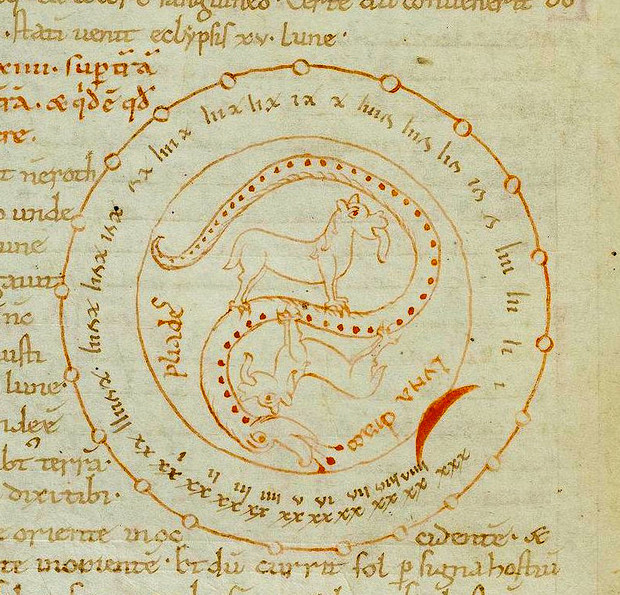
Even if the diagram is not visually very close to f68r3, I think it's interesting that the three entities Pleiades, Dragon and Moon do appear to have a connection documented in European medieval manuscripts. I believe this could be slightly more convincing that the Indian frescos.
The discussion of moon eclipses from the paper linked above:
While search manuscripts to include in the 116v I am doing with Koen, I stumbled upon a source that provides a geographically closer parallel to that idea: the work discussed in this paper by Isabelle Draelants: You are not allowed to view links. Register or Login to view., 2021.
Draelants wrote:This work of cosmogony, astronomy, and computus science (a calculation that determines the calendar dates) is a strange and still rather unknown Latin treatise compiled, to all appearances, sometime between the sixth and the middle of the tenth century.
The work contains many illustration, mostly rotae i.e. circular astronomical diagrams. Surviving illustrated copies:
- You are not allowed to view links. Register or Login to view., fols. 203r–229r , Chartres, 12th C.
- You are not allowed to view links. Register or Login to view., fols.1r-26r, Siena, 13th C.
- You are not allowed to view links. Register or Login to view.. fols. 1r-19v, S.Italy?, 11th C.
- You are not allowed to view links. Register or Login to view., fols. 1r-31r, England, 12th C.
The text appears to be very interesting, but what stroke me is a particular diagram (in particular in the Vatican ms) where a snake is shown between the moon (represented by a crescent) and a label for Pleiades (Pliades). The text says that the Pleiades are moon's enemies and eclipses of the moon are caused by "the dragon of the Pleiades".
This is the illustration from the Vatican manuscript: (f.10v). The numbers and small circles on the diameter of the rota represent the mansions of the moon. The presence of the bears is discussed in the quote below.
Even if the diagram is not visually very close to f68r3, I think it's interesting that the three entities Pleiades, Dragon and Moon do appear to have a connection documented in European medieval manuscripts. I believe this could be slightly more convincing that the Indian frescos.
The discussion of moon eclipses from the paper linked above:
Draelants wrote:Referring to eclipses, the author uses various expressions such as obscuritas, nigredo, inimicitia (chap. 22, chap. 38: eclipsis, nigredo; chap. 36, chap. 41: obscuritas, obscuratio; chap. 36: umbra caude Pliadum; chap. 38: umbra ursi; chap. 23, “Que sunt inimicitie Pliadum ac Lune et quomodo ad tempus obscurent eam” (What are the enmities between the Pleiades and the Moon and how they obscure it at some times)). In the drawings, he also often refers to old mythical zoological forms of representation like the umbra ursi, as in chapter 38, where it states: “Respondit Nemroth dicens, sicut vides pictum, ita est expositio de qua me interrogasti. Et ne dubites, vide, hoc sunt radii solis, nigre autem sunt in umbra ursi” (Nemroth answered, saying: as you see it depicted, this is the explanation about which you asked me. And so that you have no doubt, here are the rays of the Sun, they are black in the shadow of the Bear) (Ms. Va, fol. 11r). The terms draco Pliadum (“the dragon of Pleiades”, chap. 22) or Pliades draconum (“the Pleiades of the dragons”, chap. 21) or umbra caude Pliadum (“the shadow of the tails of the Pleiades”, chap. 36), are probably all corrupted forms of an original different term used to describe this dragon, since the Pleiades have nothing to do with eclipses. Nonetheless, using these terms, the LN also represents the Dragon of eclipses that very likely evokes the “Chaldean” snake, depicting what we call today the lunar nodes as the Dragon’s head and Dragon’s tail. It is clear that the illustrator is under the troubling influence of traditional Roman ancient iconography that represents the northern constellation of the Draco together with the Bears (Ursae). In the mythical astronomy of Mesopotamia, the snake, termed in Syriac Atalia, was thought to cast a shadow over or even eat the Moon and to be responsible for provoking the eclipses when the Moon crossed the apparent path of the Sun in the sky. 32 Speaking about eclipses in a geocentric world, the ascending node is where the orbiting Moon moves north through the ecliptic, and the descending node is where it moves south through it. This is depicted in several pictures of the LN. For example, Illustration 23 of the LN (Figure 3.7) represents the thirty lunar phases around the Pleiades’ Dragon and the Bears, and corresponds to chapter 36, De eclipsi lune.
![[+]](https://www.voynich.ninja/images/collapse_collapsed.png)