


13-07-2021, 06:26 PM
(This post was last modified: 13-07-2021, 07:38 PM by Torsten.
Edit Reason: small change
)
To illustrate the connections between Hands and TF-IDF topics Figure 18 is used. (The nodes in this graph are the categories in consideration (hands, TF-IDF topics) and the edges are the pages which link the hands to topics (p. 12).)
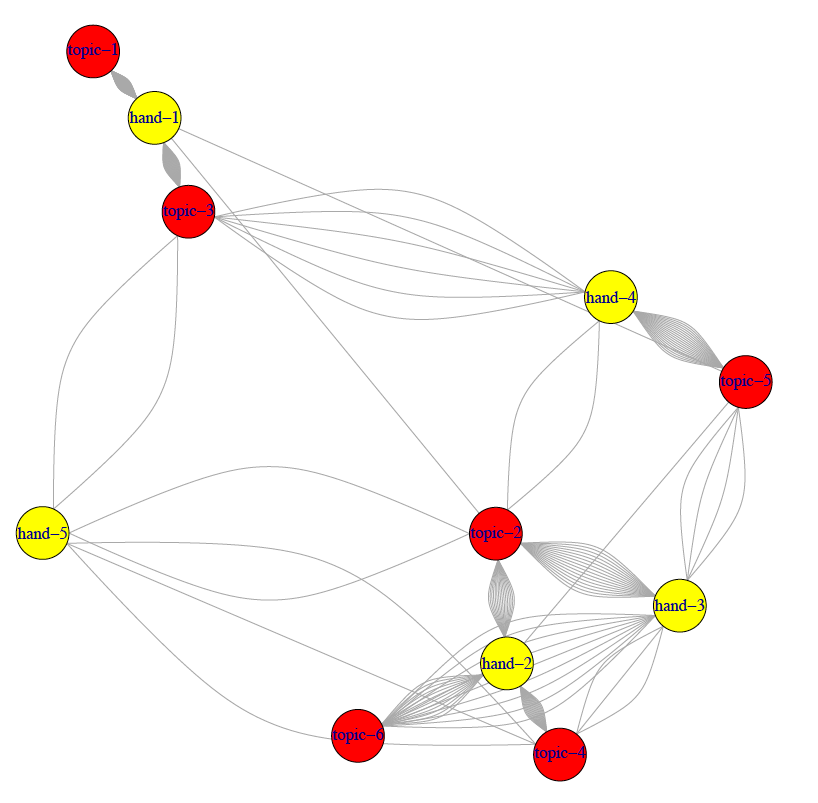
Figure 18 demonstrates that TF-IDF topics distinguish between Currier A and B. There are two topics for Currier A (topic 1 and 3) and three topics for Currier B (topics 2, 4, and 6). It is also observable that Hand 5 is not related to any topic, that Hand 1 is equivalent to Currier A and that Hand 2 and 3 do cover Currier B. Hands 2 and 3 are connected with each other since "topic 2 is equally split between Hands 2 and 3" (p. 11). Only for Hand 4 a one-to-one mapping to a topic exists: "the astrological section is always clustered next to hand 4" (p. 15).
In essence the paper demonstrates that it is possible to distinguish between Currier A and B, that labels behave differently from plain text and that there is a connection between the stars and the balneological section. None of this is a surprise. Renè Zandbergen already presented similar results of a cluster analysis on his website (You are not allowed to view links. Register or Login to view.).
What is surprising is the conclusion "We find that computationally derived clusters match closely to a conjunction of scribe and subject matter (as per the illustrations)" (p. 1). Actually the paper demonstrated quite the opposite: "In the previous analyses, we showed how TF-IDF topics do not clearly match to either Hands or Illustrative sections, though there is some overlap in association with both" (p. 11). This means that neither the assumption of scribal differences nor subject changes would explain the changes in word frequencies as observed.
But even if it would be possible to build a one-to-one mapping to illustrations and also to scribal hands this would be problematic. Topic changes are either the result of subject changes or they occur because the text representation does change. Sterneck et al. try to explain topic changes both ways. But this only means that the claim of meaningless 'dialect' differences weakens the claim of meaningful subject changes and vice versa.
Figure 18 demonstrates that TF-IDF topics distinguish between Currier A and B. There are two topics for Currier A (topic 1 and 3) and three topics for Currier B (topics 2, 4, and 6). It is also observable that Hand 5 is not related to any topic, that Hand 1 is equivalent to Currier A and that Hand 2 and 3 do cover Currier B. Hands 2 and 3 are connected with each other since "topic 2 is equally split between Hands 2 and 3" (p. 11). Only for Hand 4 a one-to-one mapping to a topic exists: "the astrological section is always clustered next to hand 4" (p. 15).
In essence the paper demonstrates that it is possible to distinguish between Currier A and B, that labels behave differently from plain text and that there is a connection between the stars and the balneological section. None of this is a surprise. Renè Zandbergen already presented similar results of a cluster analysis on his website (You are not allowed to view links. Register or Login to view.).
What is surprising is the conclusion "We find that computationally derived clusters match closely to a conjunction of scribe and subject matter (as per the illustrations)" (p. 1). Actually the paper demonstrated quite the opposite: "In the previous analyses, we showed how TF-IDF topics do not clearly match to either Hands or Illustrative sections, though there is some overlap in association with both" (p. 11). This means that neither the assumption of scribal differences nor subject changes would explain the changes in word frequencies as observed.
But even if it would be possible to build a one-to-one mapping to illustrations and also to scribal hands this would be problematic. Topic changes are either the result of subject changes or they occur because the text representation does change. Sterneck et al. try to explain topic changes both ways. But this only means that the claim of meaningless 'dialect' differences weakens the claim of meaningful subject changes and vice versa.
![[+]](https://www.voynich.ninja/images/collapse_collapsed.png)