


I am glad that linguists at Yale are proceeding in their research! I understood very little of the maths behind this work, but the overall concepts are clear enough.
Here are a few random comments:
This does not appear to be consistent with Figure 1, where the herbal pages intermixed with the "pharmaceutical" pages are assigned to the "pharmaceutical" section. In other words, "sections" in Figure 1 do not appear to be based on the illustrations. Were the "herbal" pages f90-96 treated as belonging to the "pharmaceutical" (as Figure1 suggests)?
Stolfi is misspelled as "Stolti". Also I am not sure that the transliteration used can be "Takahashi’s version of the text (as corrected by Zandbergen and Stolfi)": IIRC, Takahashi's file does not include the Rosettes. So maybe the Zandbergen-Landini EVA file was used?
In paragraph 2.2.2 "pharmaceutical" and "starred/recipes" are listed as sections, while in Figure 3 topic_starred and topic_recipes appear. I guess that in Figure 3 (and in most of the paper) "recipes" stands for "pharmaceutical"? It would help if sections were named consistently.
It would be interesting if the page-level plots (like Figure 8) included both the colour-encoded topic classification and illustration-type classification (e.g. as point shape). In particular, I would be curious to see the distribution of Herbal A / Herbal B pages: I doubt they can be assigned to a single topic. Also, how do the "pharmaceutical" (i.e. "small-plants") pages behave with respect to Herbal A and Herbal B? Do they turn out to be somehow "intermediate" between the two sets?
Also for Figure 12, one could find a way to show topics and hands at the same time for each sample. The node-edge graphs at the end (16,17,18) make some of this information visible, but I find them difficult to read (possibly because I am not familiar with this format).
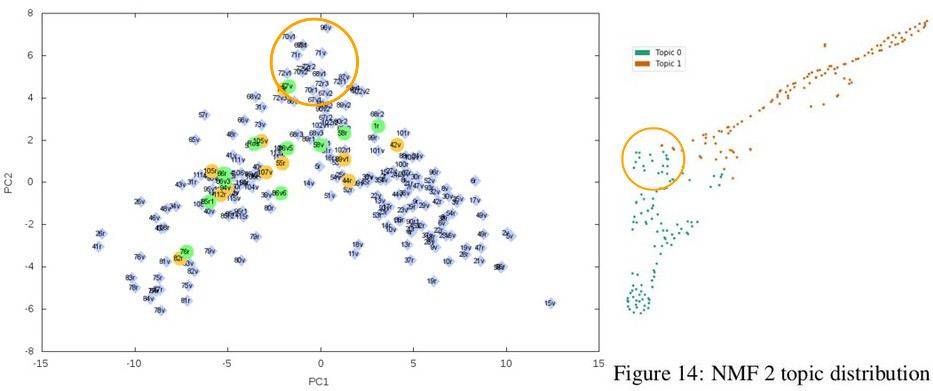
I found paragraph "4.6 Analysis 6: NMF topics vs. Currier languages" and Figure 14 particularly interesting. I think it is clear that Voynichese cannot be split into two languages A and B; I am still uncertain about a single continuum as Torsten's thinks and a set of discreet dialects. Anyway, what is interesting is that word structure varies together with the illustrations; a well known example is the frequency of You are not allowed to view links. Register or Login to view. in the "pharmaceutical" pages.
I would definitely love to see a more extensive discussion of the relations between "topics" and word structure.
I also find the cloud in Figure 14 somehow comparable with what I got by plotting the 2 principal components (PCA) of You are not allowed to view links. Register or Login to view.. I wonder if the tip of the V consists of Astro and Pharma pages also for the topics plot.
Typo here: "nodes in the network are the categories under consideration (hand, illustrated sections, TF-IDF topics, etc), and the edges are the pages the [that] link the hands to sections or topics"
The fundamental distinction between function words and content words is mentioned in the paper. I believe this is a field that could be explored in greatest depth. The methods used in the paper are apparently based on the idea that words in the different sections are comparable:
While there are a few words that appear through the manuscript, the identification of function words is problematic (this has been also discussed by Torsten).
One can assume that the top 4 most frequent words in the Balneological section (Quire 13) are function words: Shedy chedy qokedy qokain
These cumulatively appear 711 times and make up 11% of the text.
But each of these words only appears once in the Pharma section. What is happening here. The word frequencies in each section are compatible with some of the words being function words, but the fact that they are not shared among sections suggests that they appear in different forms. This could contradict the consistency assumption quoted above.
I am looking forward to see how this research develops and if some light can be shade on the peculiar word structure of Voynichese and the distribution of word types across sections. BTW, also the fact that word structure is fairly consistent across sections while word frequencies vary so much is very puzzling.
Here are a few random comments:
Quote:On the basis of illustrations which accompany the text, it is customary to divide the manuscript into five sections. 1. botanical/herbal 2. astrological/astronomical 3. balneological 4. pharmaceutical 5. starred paragraphs/“recipes”
This does not appear to be consistent with Figure 1, where the herbal pages intermixed with the "pharmaceutical" pages are assigned to the "pharmaceutical" section. In other words, "sections" in Figure 1 do not appear to be based on the illustrations. Were the "herbal" pages f90-96 treated as belonging to the "pharmaceutical" (as Figure1 suggests)?
Stolfi is misspelled as "Stolti". Also I am not sure that the transliteration used can be "Takahashi’s version of the text (as corrected by Zandbergen and Stolfi)": IIRC, Takahashi's file does not include the Rosettes. So maybe the Zandbergen-Landini EVA file was used?
In paragraph 2.2.2 "pharmaceutical" and "starred/recipes" are listed as sections, while in Figure 3 topic_starred and topic_recipes appear. I guess that in Figure 3 (and in most of the paper) "recipes" stands for "pharmaceutical"? It would help if sections were named consistently.
It would be interesting if the page-level plots (like Figure 8) included both the colour-encoded topic classification and illustration-type classification (e.g. as point shape). In particular, I would be curious to see the distribution of Herbal A / Herbal B pages: I doubt they can be assigned to a single topic. Also, how do the "pharmaceutical" (i.e. "small-plants") pages behave with respect to Herbal A and Herbal B? Do they turn out to be somehow "intermediate" between the two sets?
Also for Figure 12, one could find a way to show topics and hands at the same time for each sample. The node-edge graphs at the end (16,17,18) make some of this information visible, but I find them difficult to read (possibly because I am not familiar with this format).
I found paragraph "4.6 Analysis 6: NMF topics vs. Currier languages" and Figure 14 particularly interesting. I think it is clear that Voynichese cannot be split into two languages A and B; I am still uncertain about a single continuum as Torsten's thinks and a set of discreet dialects. Anyway, what is interesting is that word structure varies together with the illustrations; a well known example is the frequency of You are not allowed to view links. Register or Login to view. in the "pharmaceutical" pages.
I would definitely love to see a more extensive discussion of the relations between "topics" and word structure.
I also find the cloud in Figure 14 somehow comparable with what I got by plotting the 2 principal components (PCA) of You are not allowed to view links. Register or Login to view.. I wonder if the tip of the V consists of Astro and Pharma pages also for the topics plot.
Typo here: "nodes in the network are the categories under consideration (hand, illustrated sections, TF-IDF topics, etc), and the edges are the pages the [that] link the hands to sections or topics"
The fundamental distinction between function words and content words is mentioned in the paper. I believe this is a field that could be explored in greatest depth. The methods used in the paper are apparently based on the idea that words in the different sections are comparable:
Quote:Although we cannot read the Voynich text, topic modeling is still applicable if we assume that Voynich words have a consistent form-meaning correspondence across the manuscript. That is, we need to assume that 8ain on You are not allowed to view links. Register or Login to view. is the SAME word as 8ain on f7v.
While there are a few words that appear through the manuscript, the identification of function words is problematic (this has been also discussed by Torsten).
One can assume that the top 4 most frequent words in the Balneological section (Quire 13) are function words: Shedy chedy qokedy qokain
These cumulatively appear 711 times and make up 11% of the text.
But each of these words only appears once in the Pharma section. What is happening here. The word frequencies in each section are compatible with some of the words being function words, but the fact that they are not shared among sections suggests that they appear in different forms. This could contradict the consistency assumption quoted above.
I am looking forward to see how this research develops and if some light can be shade on the peculiar word structure of Voynichese and the distribution of word types across sections. BTW, also the fact that word structure is fairly consistent across sections while word frequencies vary so much is very puzzling.
![[+]](https://www.voynich.ninja/images/collapse_collapsed.png)