


12-05-2020, 12:33 AM
(This post was last modified: 12-05-2020, 08:00 AM by Torsten.
Edit Reason: typo
)
If it comes to undeciphered scripts I find it important to verify any argument given at least twice. Thankfully, the article contains a table with associations of folios to scribes as well as the criteria used for the assignments. Therefore it is possible to verify the assignments.
These are my main findings so far:
1) In the case of the [h] (EVA-[k]) the criteria for the scribes 1, 3, and 5 sound very similar to each other. In the case of scribe 3 the [h] is indeed "slightly more compact" but only since the whole writing is more compact. The "very slightly foot" (scribe 1) and the "minuscle tick at the foot" (scribe 5) are in my eyes just different words to describe the same observation.
2) The article didn't discuss the fact that a wide variety of glyph forms exists for both glyphs even for a single page. See for instance the different foot sizes for [h] on a folio assigned to scribe 1 (You are not allowed to view links. Register or Login to view.):

3) The given criteria for [m] and [n] (EVA-[in]) for scribe 5 is a [m] with "a long, low final that finishes above the penultimate minim". If we check all instances of [m] and [n] the outcome is a wide range of forms. Decide yourself how many of the glyphs fit the given criteria:
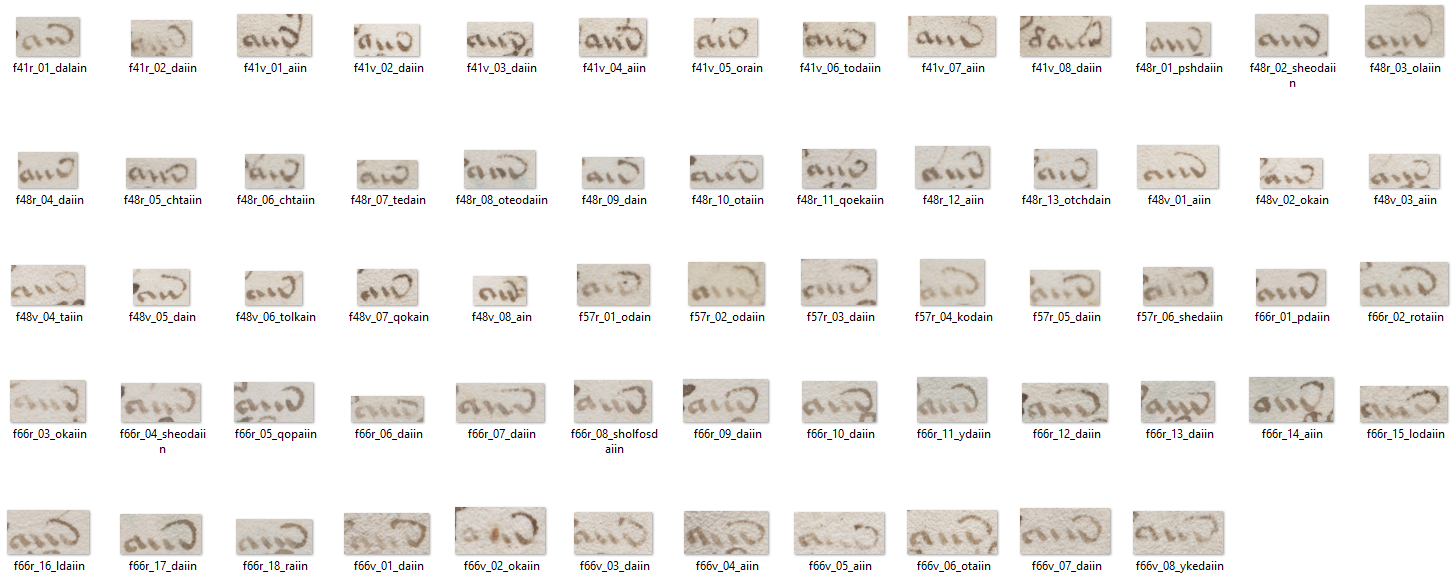
(you can also verify it yourself by using You are not allowed to view links. Register or Login to view.)
4) In case of scribe 4 it is hard to find further examples of glyphs matching the criteria for scribe 4. Even on the rosette folio itself the tall [m] "with only a slight curvature" is an exception:
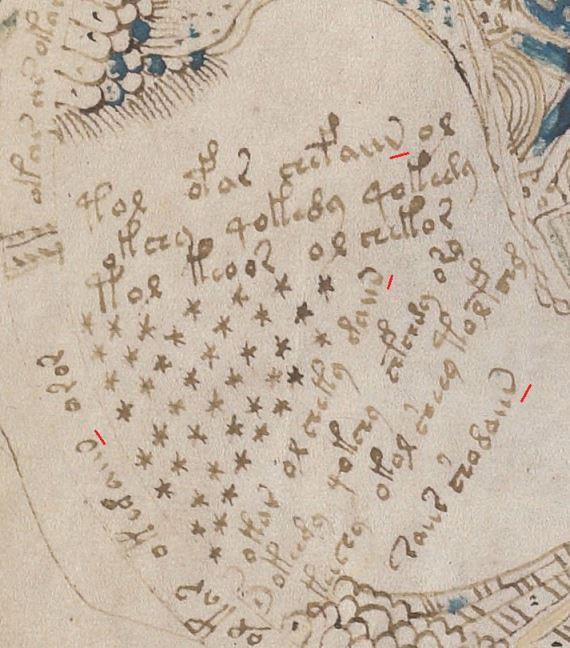
And also on other pages assigned to scribe 4 it is hard to find further instances of [h] with a "prominent final foot" or an [m] or [n] "with only a slight curvature".
(see You are not allowed to view links. Register or Login to view. and You are not allowed to view links. Register or Login to view.)
Maybe it is possible to name other criteria to distinguish between scribes. But based on the criteria presented in this article I came to the conclusion that the variance for the selected glyphs on a single page is too high to use this criteria to distinguish even between two different scribes.
These are my main findings so far:
1) In the case of the [h] (EVA-[k]) the criteria for the scribes 1, 3, and 5 sound very similar to each other. In the case of scribe 3 the [h] is indeed "slightly more compact" but only since the whole writing is more compact. The "very slightly foot" (scribe 1) and the "minuscle tick at the foot" (scribe 5) are in my eyes just different words to describe the same observation.
2) The article didn't discuss the fact that a wide variety of glyph forms exists for both glyphs even for a single page. See for instance the different foot sizes for [h] on a folio assigned to scribe 1 (You are not allowed to view links. Register or Login to view.):
3) The given criteria for [m] and [n] (EVA-[in]) for scribe 5 is a [m] with "a long, low final that finishes above the penultimate minim". If we check all instances of [m] and [n] the outcome is a wide range of forms. Decide yourself how many of the glyphs fit the given criteria:
(you can also verify it yourself by using You are not allowed to view links. Register or Login to view.)
4) In case of scribe 4 it is hard to find further examples of glyphs matching the criteria for scribe 4. Even on the rosette folio itself the tall [m] "with only a slight curvature" is an exception:
And also on other pages assigned to scribe 4 it is hard to find further instances of [h] with a "prominent final foot" or an [m] or [n] "with only a slight curvature".
(see You are not allowed to view links. Register or Login to view. and You are not allowed to view links. Register or Login to view.)
Maybe it is possible to name other criteria to distinguish between scribes. But based on the criteria presented in this article I came to the conclusion that the variance for the selected glyphs on a single page is too high to use this criteria to distinguish even between two different scribes.
![[+]](https://www.voynich.ninja/images/collapse_collapsed.png)