


07-05-2020, 07:32 PM
(This post was last modified: 07-05-2020, 07:33 PM by Torsten.
Edit Reason: typo
)
I have read your inspiring paper. While reading it I stumbled over some questions and would be glad if you would answer them.
The first two questions came already into my mind while watching the You are not allowed to view links. Register or Login to view. with your lecture from the annual meeting of the Bibliographical Society of America. I have postponed this questions since I had hoped to find the answers in your paper.
You say that you initially annotated several different characters, but than decided to focus on v101-[h] (=EVA-[k]). But why did you limited the analysis to just two glyphs? Wouldn't it be helpful to cross check the result by comparing additional glyphs?
Why did you select [h] and [m]/[n] as glyphs for determining different scribes?
How did you handle the large variety of shapes for [h] and [m]/[n] on a single page? Let me give an example to illustrate what I mean. After your criteria Scribe 1 writes [m] and [n] "with a backward flourish that stretches as far as the penultimate minim." But if we expand the section for Scribe 1 in figure 7 (folio 36v) it is also possible to find variants with a short backward stroke, barely passing the final minim:
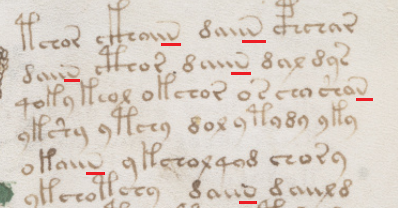 [Part of folio 36v]
Folio 36v as well as folio 99r are both attributed to Scribe 1. But if we compare folio 99r with folio 36v it seems as if [h]-glyphs on folio 99r are written with a larger loop and a more prominent foot than on folio 36v. What would you say to the hypotheses that Scribe 1 was becoming more fluent while writing the (probably newly invented)script?
 [Part of folio 99r]
You say [h] written by Scribe 3 is similar to that of Scribe 1, although slightly more compact. But didn't that mean that it is not possible to use [h] to distinguish between Scribe 1 and Scribe 3 given that Scribe 3 writes more compact in the first place?
You also say that [h] written by Scribe 4 has a perpendicular crossbar, an oversize loop, and a prominent foot. But if I look on the very first folio attributed to Scribe 4 (folio 67r1) I find it hard to find any [h]-glyph that matches the given description. What have I overlooked?
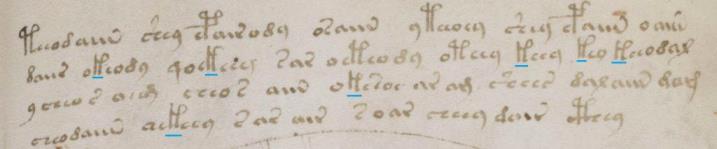 [Top of folio 67r1]
The first two questions came already into my mind while watching the You are not allowed to view links. Register or Login to view. with your lecture from the annual meeting of the Bibliographical Society of America. I have postponed this questions since I had hoped to find the answers in your paper.
You say that you initially annotated several different characters, but than decided to focus on v101-[h] (=EVA-[k]). But why did you limited the analysis to just two glyphs? Wouldn't it be helpful to cross check the result by comparing additional glyphs?
Why did you select [h] and [m]/[n] as glyphs for determining different scribes?
How did you handle the large variety of shapes for [h] and [m]/[n] on a single page? Let me give an example to illustrate what I mean. After your criteria Scribe 1 writes [m] and [n] "with a backward flourish that stretches as far as the penultimate minim." But if we expand the section for Scribe 1 in figure 7 (folio 36v) it is also possible to find variants with a short backward stroke, barely passing the final minim:
Folio 36v as well as folio 99r are both attributed to Scribe 1. But if we compare folio 99r with folio 36v it seems as if [h]-glyphs on folio 99r are written with a larger loop and a more prominent foot than on folio 36v. What would you say to the hypotheses that Scribe 1 was becoming more fluent while writing the (probably newly invented)script?
You say [h] written by Scribe 3 is similar to that of Scribe 1, although slightly more compact. But didn't that mean that it is not possible to use [h] to distinguish between Scribe 1 and Scribe 3 given that Scribe 3 writes more compact in the first place?
You also say that [h] written by Scribe 4 has a perpendicular crossbar, an oversize loop, and a prominent foot. But if I look on the very first folio attributed to Scribe 4 (folio 67r1) I find it hard to find any [h]-glyph that matches the given description. What have I overlooked?