





For a long time I've thought of the VMS feline as being maneless, but I took a close look at it again a few weeks ago and now I'm not so sure.
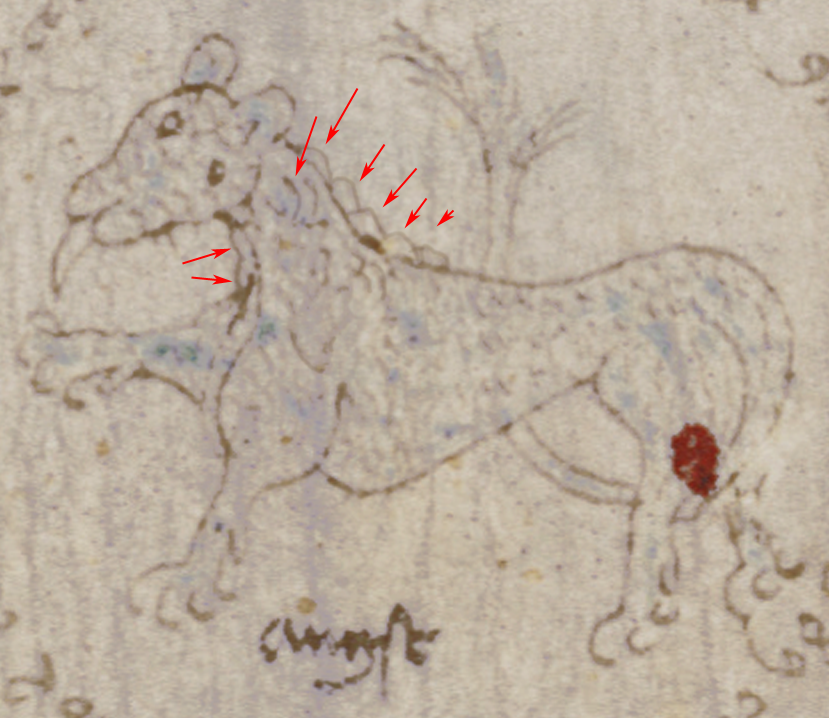
Of course, I was expecting a normal lion mane, if it had a mane (in other words if it was a lion rather than a leopard, for example), but when I took another look at these extra lines, which I darkened a little and marked with arrows, it suddenly occurred to me that the illustrator has added a horse's mane to a feline, which would suggest it was someone who had never seen a lion but maybe was told it has a mane (which to most people means horse's mane).
Either that, or it's a feline with dragon bumps on the back of its neck, but there are bumps on the back of the lower neck also, which is what it looks like when a horse's mane hangs down on the far side instead of the near side.
Now surely the person has seen drawings of lions, and should know the mane comes all the way around but if you didn't understand that's how a lion's mane grows, you might assume it was like a horse's mane with the mane part on the side facing the viewer.
Lions in relief (seen flatter than a full sculpture) were more common than full sculptures, and misconceptions about the mane could occur with a relief sculpture but it depended on where a person lived whether they had seen a full sculpture that could be seen from all sides. I don't know how common they were.
Anyway, there are some extra lines and bumps that don't show up well that might be worth scrutinizing. Is it an oddly drawn mane or something else?
Cheetahs have a slight suggestion of a mane (more similar to a boar than a horse) when they feel threatened and they fluff up, but most of the time it's not very apparent. You would have to know them very well to ever see it.
The King cheetah has a more obvious mane, but it's almost black, it stands straight up, and the King cheetah is a very rare animal, much more rare than cheetahs that are featured on nature videos.
Of course, I was expecting a normal lion mane, if it had a mane (in other words if it was a lion rather than a leopard, for example), but when I took another look at these extra lines, which I darkened a little and marked with arrows, it suddenly occurred to me that the illustrator has added a horse's mane to a feline, which would suggest it was someone who had never seen a lion but maybe was told it has a mane (which to most people means horse's mane).
Either that, or it's a feline with dragon bumps on the back of its neck, but there are bumps on the back of the lower neck also, which is what it looks like when a horse's mane hangs down on the far side instead of the near side.
Now surely the person has seen drawings of lions, and should know the mane comes all the way around but if you didn't understand that's how a lion's mane grows, you might assume it was like a horse's mane with the mane part on the side facing the viewer.
Lions in relief (seen flatter than a full sculpture) were more common than full sculptures, and misconceptions about the mane could occur with a relief sculpture but it depended on where a person lived whether they had seen a full sculpture that could be seen from all sides. I don't know how common they were.
Anyway, there are some extra lines and bumps that don't show up well that might be worth scrutinizing. Is it an oddly drawn mane or something else?
Cheetahs have a slight suggestion of a mane (more similar to a boar than a horse) when they feel threatened and they fluff up, but most of the time it's not very apparent. You would have to know them very well to ever see it.
The King cheetah has a more obvious mane, but it's almost black, it stands straight up, and the King cheetah is a very rare animal, much more rare than cheetahs that are featured on nature videos.