





17-09-2018, 10:47 AM
(This post was last modified: 17-09-2018, 11:22 AM by -JKP-.
Edit Reason: Edit: added a picture
)
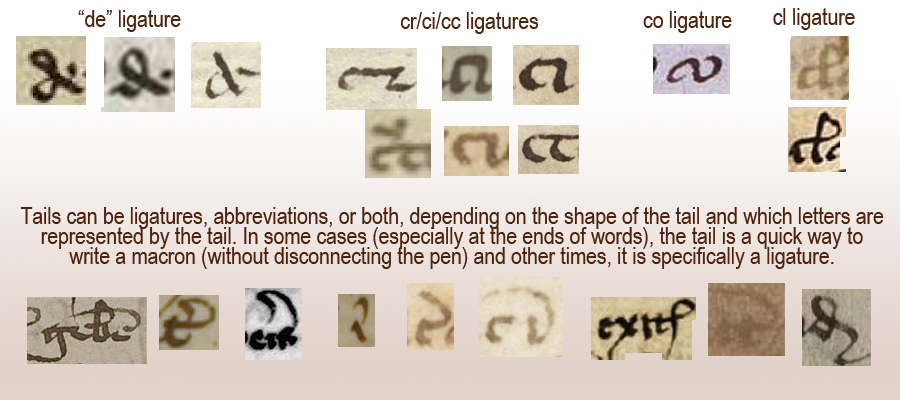
In Latin, "fused glyphs" are called ligatures and they are as much a part of Latin script as abbreviations. In fact, some of the Latin abbreviations are also ligatures.
For example, adding a tail to a letter (like adding a tail to e or c or t or r) is normal practice. Shapes like EVA-r and EVA-s are not just normal in Latin, they are common. The tail is not an embellishment, it has meaning. Sometimes it is intepreted the same as the macron (which usually stands for n or m) and sometimes it stands for the same thing as the "smoke symbol" apostrophe, which often represents "er".
Another very common ligature (fused glyph) in Latin is cc/ec/er/et/ce, which looks like EVA-ch in Voynichese.
Edit [addition]: Here are some examples. These aren't the best, they are what I could grab quickly, but it's probably enough to give the idea:
For example, adding a tail to a letter (like adding a tail to e or c or t or r) is normal practice. Shapes like EVA-r and EVA-s are not just normal in Latin, they are common. The tail is not an embellishment, it has meaning. Sometimes it is intepreted the same as the macron (which usually stands for n or m) and sometimes it stands for the same thing as the "smoke symbol" apostrophe, which often represents "er".
Another very common ligature (fused glyph) in Latin is cc/ec/er/et/ce, which looks like EVA-ch in Voynichese.
Edit [addition]: Here are some examples. These aren't the best, they are what I could grab quickly, but it's probably enough to give the idea:
