
+- The Voynich Ninja (https://www.voynich.ninja)
+-- Forum: Voynich Research (https://www.voynich.ninja/forum-27.html)
+--- Forum: Analysis of the text (https://www.voynich.ninja/forum-41.html)
+--- Thread: Traces of a wheel or similar (/thread-6139.html)
Pages:
1
2
Traces of a wheel or similar - takrobat - 01-10-2026
Hi,
I have been studying the text statistically the last days, and want to know if anyone else have noticed this.
I know tavie and MarcoP have shown that a line's first glyph depends on the line above, what I have found is that there is some sort of direction to this. Among d, q and y, consecutive line starts step d -> q -> y -> d more often than the reverse.
Example :
<f79v.13,+P0> dain.ar.olshey.dytain.qokain.checthy.okeedy.qokeedy.ror
<f79v.14,+P0> qokeey.qokedy.okeey.qokol.sheedy.qokeedy.rolchey.qokeedy
<f79v.15,+P0> yteedy.qokeedy.qokain.olkeey.cheokain.dy,teey.qokain
<f79v.16,+P0> dol.sheey.qol.olkshey.qokeedy.olkeedy.qol.okaiin.oly
These are the counts for the whole manuscript:
forward: d→q 125 q→y 75 y→d 119 (total 319)
backward: q→d 75 y→q 35 d→y 81 (total 191)
Total the wheel moves forward 63% of the time (expected 50%). The difference is about 5.7 standard deviations from the expected. Permutation tests give the same result (p<0.0001).
Frequencies alone can not produce this, if it had fixed probablities (50% d, 30% q, 20% y) the count would be expected to be the same in both directions (0.5*0.3==0.3*0.5).
This is valid through the whole document, not just parts of it. It could appear everywhere.
It also seems like ONLY the line preceding the line counts. Both lines need to have d,q or y to see this pattern. If one line appears between them, the pattern disappears (or so my initial investiagation shows). It seems like the scribe looks at the preceding line ONLY when dealing with d,q,y changes. There is no hidden "counter" keeping track.
The first line of a paragraph is outside (often other glyphs).
What I have checked:
Two transcriptions give the same result (ZL3b and voynichese.com)
Currier A,B and different scribes all follow the "rule".
It goes from start to start, not a seam between line breaks.
It is JUST the first glyph - no matter what the rest of the word is.
Currier A also has a similar rule, it seems : y-o-q-y
I can not find any direction anywhere else line to line.
What does it mean?
It could mean that some rule is governing these letters. It *could* be a wheel that is cycled, or some sort of weighted random variable. It seems like they move forward 2 of 3 times, roughly. Backwards 1/3 of the time.
RE: Traces of a wheel or similar - MarcoP - 02-10-2026
I want to point out that those findings about vertical patterns with line initials are entirely Tavi’s work, and I cannot take any credit for them. Of course, I agree that her research is of the greatest interest!
RE: Traces of a wheel or similar - DG97EEB - 02-10-2026
Yes, I agree.. I've just modelled a wheel in GPT and it works.. will post details
RE: Traces of a wheel or similar - takrobat - 02-10-2026
(02-10-2026, 08:11 PM)DG97EEB wrote: You are not allowed to view links. Register or Login to view.Yes, I agree.. I've just modelled a wheel in GPT and it works.. will post details
Interesting! Let us know.
RE: Traces of a wheel or similar - DG97EEB - 03-10-2026
What I tested
I extracted the opening glyph/state of successive running-text lines, keeping paragraph structure intact.
The first conspicuous pattern involved d, q and y, which suggested a possible three-state cycle. So I built the simplest literal model:
d → q → y → d
with allowance for staying in place, moving backwards, or leaving the cycle for another opener.
I then tested it out-of-sample, holding out whole folios rather than fitting and testing on the same text. I compared it with both:
- a model in which line openings are independent; and
- an unrestricted first-order model which is allowed to learn every opener-to-opener transition.
I also generated artificial manuscripts from the fitted model and asked whether they reproduced statistics which had not simply been fitted directly.
The simple d/q/y model initially looked remarkably good. It recovered about 87.9% of the predictive improvement obtained by the unrestricted transition model.
But that was only the beginning of the test.
The artificial texts still missed the real amount of dependency between successive openings by 17.9 standard deviations. So the attractive three-state wheel was clearly missing something.
I then progressively made the test harder.
Paragraph position
A large amount of the effect turned out to come from where a line sits within its paragraph.
Paragraph position alone carries about 0.323 bits/opener of information, approximately 8.9 SD above the null.
After accounting for that, knowing specifically about the d/q/y relationship still adds 0.0163 bits/opener, with null SD 0.00469: 3.48 SD.
So the d/q/y relationship is real.
But it is not unique.
When I tested all comparable three-opener combinations, d/q/y ranked only 13th of 165.
That was the first serious warning against interpreting the statistical pattern as one special physical d/q/y wheel.
Could there be several wheels?
I then allowed multiple transition components rather than forcing everything through d/q/y.
That did uncover strong additional structure. The best pooled two-component model gave an effect of +0.0448 bits/transition, null SD 0.00533: 8.41 SD over the shuffled control.
Adding the specifically nominated d/q/y and y/o/q cyclic components contributed another +0.00560 bits/transition, null SD 0.00156: 3.58 SD.
So there really are several structured transition tendencies at the left margin.
But the crucial question is whether these are generative wheels, rather than merely statistical descriptions of a more general scribal process.
That is where the wheel interpretation starts to fail.
On whole-quire transfer, the advantage was only +0.00864 bits/transition against null SD 0.01948. The metric does not resolve this: only 0.44 SD.
More importantly, when the fitted multi-component mechanism was actually made to generate new opener sequences, the generated manuscripts still missed the real mutual information by about 5.1 SD.
Currier B and y → o → q → y
I also tested the obvious possibility that Currier B uses a different wheel, because B contains a conspicuous y/o/q relationship.
I therefore fitted a dedicated:
y → o → q → y
generator.
It fails the generative test.
The real Currier-B sequence contains 0.0221 bits/transition more structure than the model generates, simulation SD 0.00565: 3.90 SD.
Under the stricter whole-quire test the deficit increases to 5.24 SD.
So the data do not support the proposition that Currier B simply has its own y/o/q wheel.
The ultimate test: can a wheel generate Voynichese?
Finally I stopped testing only line-openers.
I incorporated the proposed state mechanism into a complete Voynich token generator and generated whole artificial corpora.
This gives the strongest result.
Across 37,465 held-out tokens, the wheel-based generator was worse by 0.0618 bits/token, null SD 0.00772: about 8.0 SD.
It also badly missed independent properties which had not been used to fit the wheel:
- boundary behaviour missed by about 34.8 SD;
- vocabulary/type production overshot by 2,161 types, null SD 60.9: about 35.5 SD.
These failures survive paragraph, transcription, physical-block and cache controls.
So what actually survived?
Something quite interesting survived — just not the strongest version of the wheel hypothesis.
There is a real sequential process operating at the left margin.
The opener of one line helps predict the opener of the next. The process is strongly conditioned by position within the paragraph, and paragraph boundaries behave rather like resets.
A simple way of writing the surviving result is:
paragraph state + previous line opener → next line opener
There are several transition families within that process, including a genuine d/q/y relationship.
What the statistics do not tell us is how the scribe implemented that rule.
It could have been:
- remembered mentally;
- represented as a table;
- represented diagrammatically;
- represented by one or more circular diagrams;
- or conceivably implemented using a physical selector/volvelle.
Those implementations can produce essentially the same observable statistics, so the manuscript does not currently distinguish them.
What does not survive is the stronger claim that a d/q/y wheel, a Currier-B y/o/q wheel, or a small collection of such wheels is itself the mechanism generating Voynichese as a whole.
So my current conclusion is:
There really is a paragraph-local state machine at the left margin. A wheel remains a possible physical implementation of part of that procedure, but the evidence does not identify a wheel, and the tested wheel mechanisms do not generate the wider statistical structure of Voynichese.
Reproducibility
I have packaged the code, data, frozen inputs, saved simulations, independent checks and manifests into an external replay package.
Google Drive folder:
You are not allowed to view links. Register or Login to view.
The complete package is about 137 MB. Because of an upload-size limitation it is stored as two binary pieces:
"Voynich_Wheel_Research_External_Replay_20261003.zip.part00"
"Voynich_Wheel_Research_External_Replay_20261003.zip.part01"
There is also a "REASSEMBLE.txt" and the SHA-256 checksum in the folder.
On macOS/Linux:
cat Voynich_Wheel_Research_External_Replay_20261003.zip.part00 \
Voynich_Wheel_Research_External_Replay_20261003.zip.part01 \
> Voynich_Wheel_Research_External_Replay_20261003.zip
On Windows Command Prompt:
copy /b Voynich_Wheel_Research_External_Replay_20261003.zip.part00+Voynich_Wheel_Research_External_Replay_20261003.zip.part01 Voynich_Wheel_Research_External_Replay_20261003.zip
Then extract the ZIP and, from its top-level directory:
python -m venv .venv
Activate the virtual environment, then:
pip install -r requirements.txt
python verify_manifest.py
python run_all.py verify
"verify_manifest.py" checks the packaged files before anything is run.
The independent replay includes the literal d/q/y experiment, the multiple-component tests, the Currier A/B scope test, the dedicated y/o/q Currier-B test, and the final whole-token generative test.
I would be particularly interested if anyone can identify a different mechanical model which predicts the surviving paragraph-local opener behaviour without acquiring the failures of the wheel generators above.
RE: Traces of a wheel or similar - takrobat - 03-10-2026
Thank, great work!
I think some sort of directed network qith q as a hub is a better description than a wheel. In A o->q is the most normal, in B d->q is the most normal. In both q->y/ch is most normal. In herbal (A) y->o->q->y behaves like a closed cycle: when distance is 2 lines all 3 edges reverse, as predicted.
It seems to be a one line memory: once you know the line above, the line two above adds nothing (I could only test this properly in B). The reversal in A fits this, since it is just two ordinary steps around the ring. When or why the rule is broken I have found no answer for.
I will run some more analysis on this, but from your analysis:
1. Does the forward/backward asymmetry (about 63% forward) survive your paragraph-position control?
2. How much of the 0.323 bits for paragraph position comes from line 1 alone, where paragraphs start with a gallows? How much remains from line 2 on?
RE: Traces of a wheel or similar - DG97EEB - 03-10-2026
1. The ~63% forward/backward asymmetry survives paragraph entry very clearly.
Across the whole sample the d/q/y edges are 318 forward versus 190 reverse, i.e. 62.6% forward.
I reran the count excluding the first transition of every paragraph entirely - so no line 1→line 2 transitions at all. It is then 311 forward versus 178 reverse, or 63.6% forward.
The paragraph-preserving permutation test gives the same answer. On continuation lines only, the directional excess is:
- Currier A: +57.9 transitions, null SD 12.8 = 4.52 SD
- Currier B: +72.2 transitions, null SD 15.2 = 4.77 SD
So the directional asymmetry is not being produced by the special behaviour at paragraph starts.
There is also a held-out model comparison in which direction itself adds about 0.0050 bits/opener, null SD 0.0020 = 2.51 SD after accounting for the paragraph-entry regime.
2. I described the 0.323-bit result slightly misleadingly. It wasn't a general paragraph-position model.
That model only distinguishes:
line 1 versus all continuation lines (2+).
Its held-out gain over treating every line identically is 0.3229 bits/opener.
I've now decomposed that gain:
- 70.3% comes from modelling the paragraph's first line separately;
- 29.7% comes from modelling all continuation lines as a separate pooled population.
In absolute corpus-wide terms that is 0.2270 bits/opener from line 1 and 0.0959 from continuation lines.
So yes, the gallows-heavy/special first line is responsible for most of that very large 0.323-bit effect.
But importantly, removing line 1 does not remove the directional transition behaviour. In fact the raw forward proportion goes from 62.6% to 63.6%.
I therefore think your “directed network” description is closer to what the statistics actually show than my original wheel framing.
I would still separate two claims:
- there is clearly a directed opener-transition network;
- whether q is formally the hub of that network needs its own network-level test rather than choosing q after inspecting the graph.
Your one-line-memory interpretation is also consistent with our existing lag-2 test. A first-order transition matrix predicts the apparent reversal at distance two: the observed lag-2 reversal is only about 0.4 SD away from the first-order prediction. So we currently have no evidence that the line two above contributes extra information once the immediately preceding line is known.
That combination is starting to look like a special paragraph-entry regime, followed by a predominantly first-order directed continuation process, but what it all means, I still haven't figured out...
RE: Traces of a wheel or similar - bi3mw - 03-10-2026
Here's some additional information on how to get the script to run on Linux (in a virtual environment):
cd ~/Voynich_Wheel_Research_External_Replay_20261003
python3 -m venv .venv
source .venv/bin/activate
pip install numpy scipy scikit-learn
python run_all.py verify
RE: Traces of a wheel or similar - takrobat - 03-10-2026
Agreed about q being hub, and new tests shows that you are right to question this.
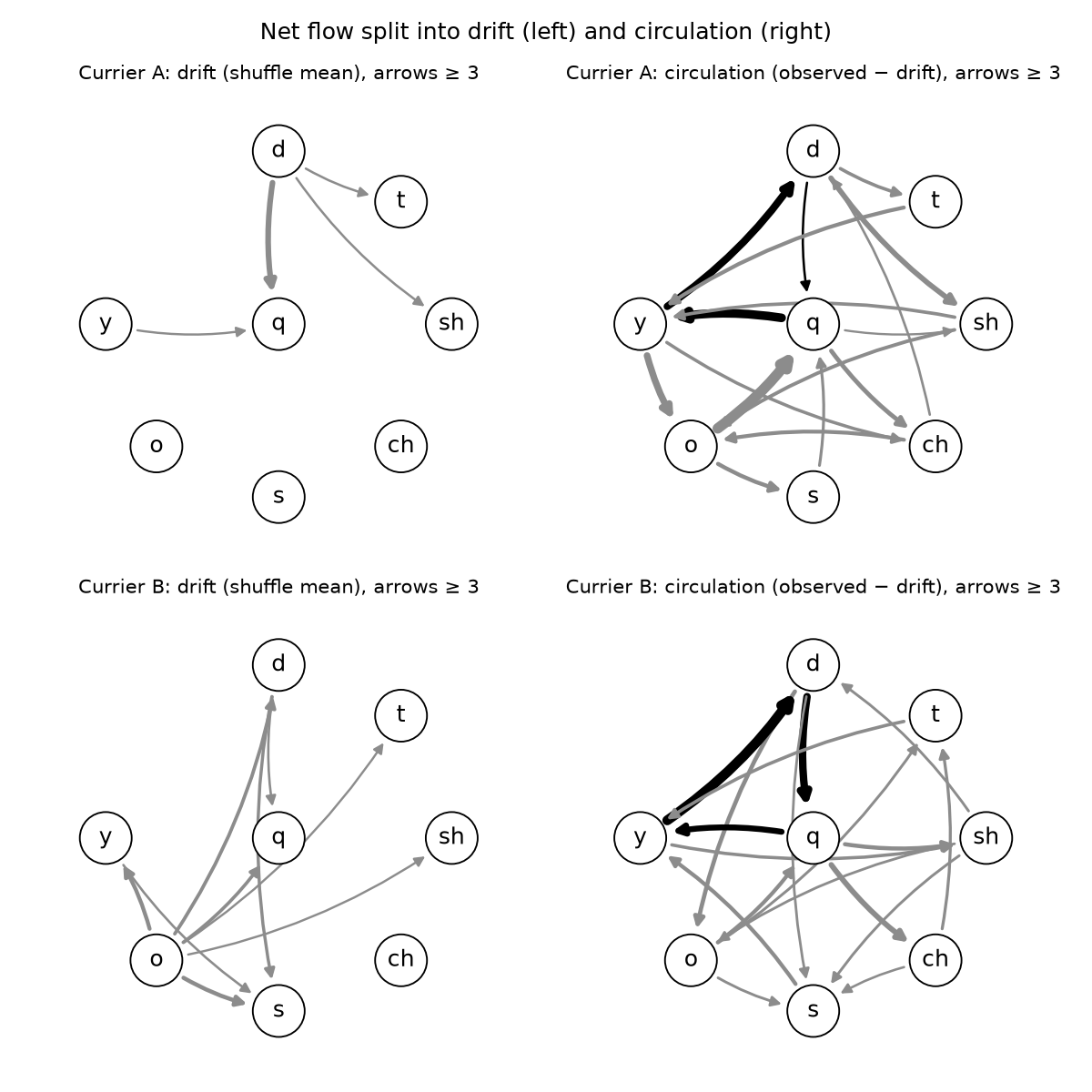
This shows drift vs circulation.
Drift is found by switching line starts between paragraphs, line 2 - midlines and last line switched separately. This is because we already know that d often is second line, and q is later line. The result is average over 1000 switches.
Circulation is what is left as a connection to the line above.
RE: Traces of a wheel or similar - takrobat - 03-10-2026
I have also tested different scribes (1-3), and the result are almost identical (and within 95% interval) between each scribe.
The selection is pretty close to 2/3 and 1/3. This is of course impossible to say for sure, but it is one of the more interesting theories. And the number itself I think is an argument against this being a selection where the scribe just has a learned bias ("use x more ofen than y"), and if so, why does all the scribes land on almos exactly the same division. This points to a process behind it, I think.
One theory is that sometimes a dice, or something similar, was used to write. But then why only on some selected glyphs, some selected times?